The $3.5 Billion Deception: How Niantic Gamified the Physical World to Power the Autonomous Future
For a decade, a cultural phenomenon appeared to be nothing more than a nostalgic fusion of a beloved franchise and augmented reality. Millions of players roamed city streets, phones held aloft, chasing virtual monsters. But to the sophisticated observer, Pokémon GO was never just a game; it was a decade-long data-mining operation disguised as a cultural phenomenon. While users were hunting Dragonites, they were actually functioning as an accidental, unpaid workforce performing a granular, high-fidelity mapping of the planet’s pedestrian layer.
The strategy has reached its logical conclusion. In a series of maneuvers that clarified its "grand design," Niantic has walked away from its billion-dollar gaming division and decommissioned its premier developer platform, 8th Wall. The objective is now singular: to leverage a massive geospatial dataset to become the essential infrastructure provider for the coming age of embodied AI and robotics.
You Weren’t the Player. You Were the Mapmaker
The central irony of the Niantic era is that the "game" was merely the incentive layer for a massive crowdsourced mapping project. Through the "Scan a PokéStop" feature and the "Wayfarer" program, Niantic mobilized millions of cameras to record surroundings in exchange for in-game trinkets. This was not mere hobbyism; it was high-level technical labor. By the time the dust settled in early 2026, Niantic had amassed over 30 billion images, creating the largest real-world robotics perception dataset in history.
From a technical perspective, the scale is staggering. Niantic has trained more than 50 million neural networks featuring over 150 trillion parameters. This allows for centimeter-level precision and "six-degree-of-freedom" (6DoF) positioning, a level of fidelity that traditional GPS cannot achieve in dense urban "canyons." Furthermore, the Wayfarer program,restricted to players level 37 and above, functioned as a sophisticated quality control layer, where community-approved curators performed the essential QA labor required to validate this massive dataset.
"Pokémon GO players have unwittingly trained AI to navigate the world." 404 Media
The $3.5 Billion "Refocus": De-risking the Infrastructure
In May 2025, Niantic executed a masterful strategic pivot by selling its entire gaming division, including Pokémon GO, Pikmin Bloom, and Monster Hunter Now, to Scopely for $3.5 billion. To the casual observer, it looked like a retreat. To an analyst, it was a brilliant "de-risking" move.
By offloading the volatile, hit-driven gaming market to Scopely, effectively the American arm used to represent the interests of the Saudi Public Investment Fund’s Savvy Games Group, Niantic successfully separated its "cash cow" entertainment assets from its "infrastructure of reality." The company then spun off its core technology into Niantic Spatial, a deep-tech entity launched with a 250millionwarchest(200 million from Niantic’s balance sheet and $50 million from Scopely). Niantic didn't lose its crown jewels; it sold the house and kept the deed to the land.
The Strategic Decommissioning of 8th Wall
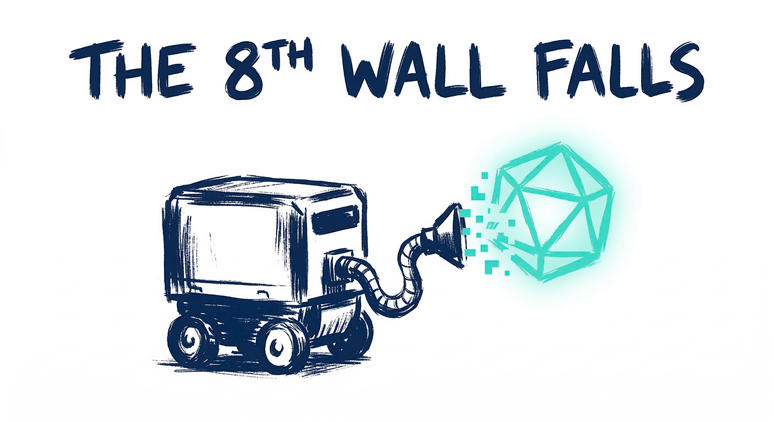
The shutdown of 8th Wall, once the gold standard for WebAR, serves as the ultimate proof of Niantic’s shift toward a "Monopoly of Intelligence." Acquired in 2022 as Niantic’s largest acquisition, 8th Wall was strategically decommissioned in February 2026 for three primary reasons:
Strategic Misalignment: 8th Wall was a marketing tool for brand activations and face filters. Niantic Spatial is focused on "Embodied AI" and robotics. Marketing fluff is now a distraction from machine navigation.
Cost and Open-Source Pressure: As open-source alternatives like AR.js gained traction, the expensive hosted model of 8th Wall became a liability.
The Monopoly of Intelligence: While Niantic moved 8th Wall to an open-source model at , they notably withheld the engine’s true power. The open-source version excludes SLAM, the Visual Positioning System (VPS), and Hand Tracking.
Niantic has essentially open-sourced the "chassis" of the platform while keeping the "engine" (the proprietary spatial intelligence) behind a private paywall.
"Pikachu to Pizza": Solving the GPS-Denied Environment
The technical synergy between gaming and logistics is absolute. Niantic’s partnership with Coco Robotics, a startup deploying delivery robots in the US and Europe, illustrates the transition from "Pikachu to Pizza."
The primary hurdle for autonomous delivery is the "GPS-denied environment." In cities, radio signals bounce off skyscrapers, rendering traditional GPS inaccurate. Niantic’s VPS allows a robot to look at a storefront or a curb and know its location within centimeters by comparing its camera feed to the 30 billion images provided by players. The computer vision problems required to make a Pikachu hide realistically behind a park bench (occlusion and depth sensing) are identical to those required for a robot to safely navigate a sidewalk.
"It turns out that getting Pikachu to realistically run around and getting Coco's robot to safely and accurately move through the world is actually the same problem." Zach Rash, CEO of Coco Robotics
The Large Geospatial Model and the Ethical Bait-and-Switch
At the heart of Niantic Spatial is the Large Geospatial Model (LGM). If Large Language Models (LLMs) like ChatGPT represent a mastery of words, the LGM represents a mastery of structure. Using techniques like Gaussian Splatting, the LGM can "understand" the physical world. If it has seen the front of a thousand churches, it can use that distributed knowledge to make an intelligent guess about what the back of a specific church looks like, even if a player never scanned it.
However, this transition has been characterized by many in the community as the "ultimate bait-and-switch." Millions of players contributed data under the impression they were supporting a game they loved. Instead, they performed the invisible labor required to build a machine-readable world for extractive industries. Niantic is now a deep-tech provider for the military-industrial complex and global logistics titans like Amazon and DoorDash, monetizing the very movements of the public that helped build the map.
The World as a Machine-Readable Workspace
Niantic’s evolution from a Google incubator to a gaming giant, and finally to an infrastructure provider, is a masterclass in long-term corporate strategy. They have successfully transitioned from a studio that makes people play in the world to a company that builds the map the world’s machines will use to work.
As Niantic transforms the planet into a machine-readable workspace, we are left with a demanding question: In the digital age, was Pokémon GO a game we won, or did we just spend a decade building the cage for our own displacement? Every time we open a free app and interact with our surroundings, we are likely performing the labor for a future that may no longer require us.