The preservation of Augmented Reality requires a paradigm shift from "freezing" technology to managing flows of data and behaviors. By treating the artwork as a system of relationships rather than a static object, and by employing strategies like migration to open web standards, we can ensure that the memory of our augmented era does not vanish with the next software update.
The conservation of contemporary cultural heritage has reached a critical turning point with the rise of Augmented Reality (AR). Unlike traditional restoration, which focuses on stabilizing physical matter like canvas or stone, AR art presents a radical ontological challenge: the artwork resides not in an object, but in a process, a behavior, and a computational system. This report synthesizes current research on the crisis of AR preservation and outlines robust strategies for ensuring the longevity of these ephemeral works.
The Crisis of "Double Obsolescence"
AR artworks face a unique topology of risk described as "double obsolescence". First, there is the rapid degradation of technological supports, including mobile hardware, operating systems, and cloud servers. Second, there is the uncontrollable mutability of the physical environment—the urban space or buildings—that serves as the anchor for the digital experience.
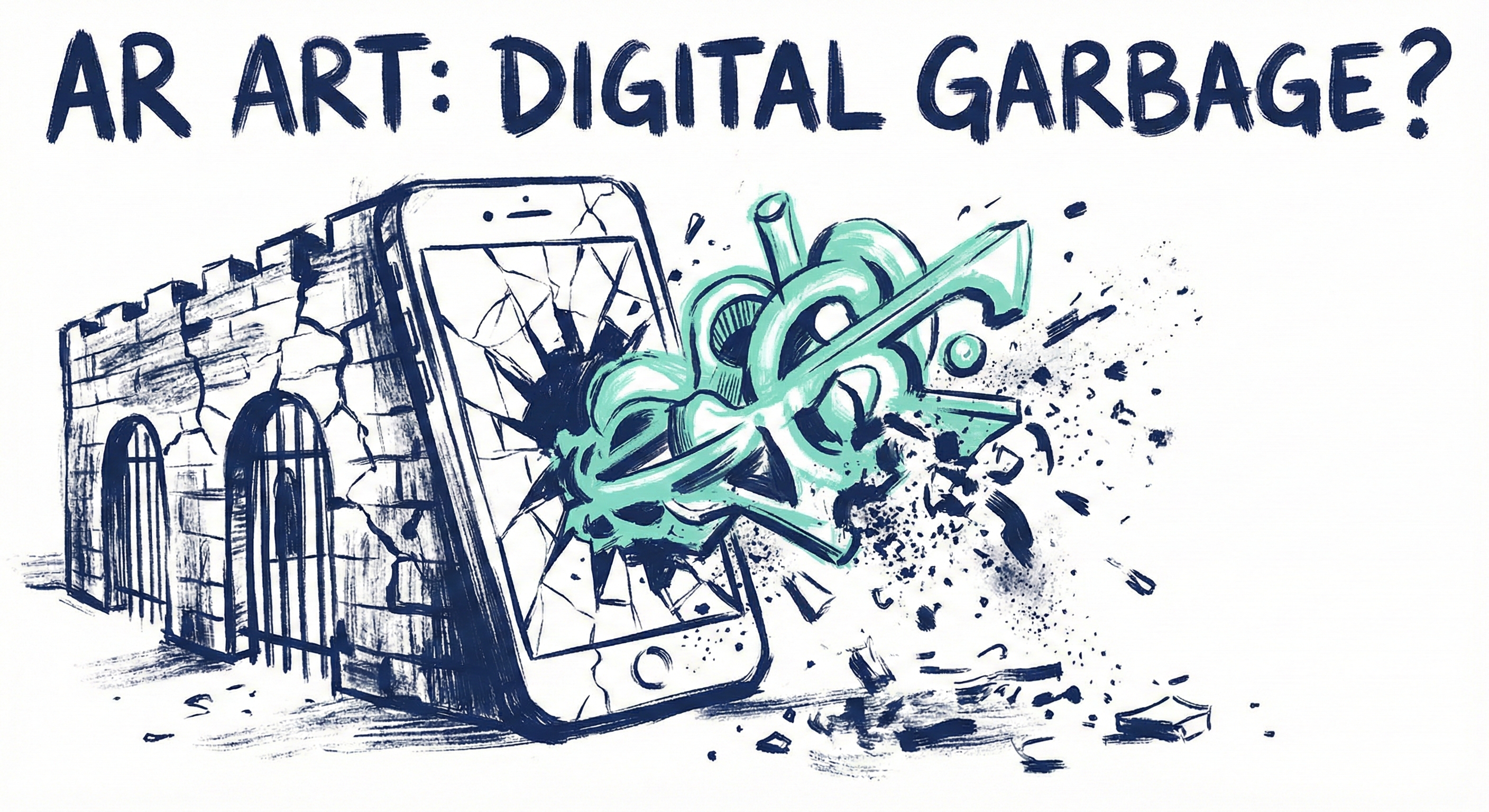
The fragility of this ecosystem was recently highlighted by the announcement of the closure of Meta Spark AR, scheduled for January 2025. This event serves as a traumatic catalyst, threatening millions of artworks with sudden disappearance due to their reliance on proprietary corporate infrastructures known as "Walled Gardens". History shows a pattern of such collapses; platforms like Layar and Aurasma (later HP Reveal) previously shut down, turning location-based art layers into "digital garbage" or leaving physical triggers that activate nothing.
Theoretical Framework: From Matter to Behavior
To preserve AR, conservators must shift from a fetishistic dependence on original hardware to a focus on the artwork's behavior. The Variable Media Initiative (VMI) provides a cornerstone for this approach, defining technological art not by its material components but by its intrinsic behaviors:
• Installed: The work is site-dependent; changes in the physical horizon affect the reading of the work.
• Interactive: The work does not exist until a user, mediated by a device, chooses to look.
• Performed: The software is a real-time process, a unique performance generated by code in response to sensor data.
This perspective aligns with the "Score" concept (Media Art Notation System), which proposes that AR should be preserved like music: through a score that describes algorithms, assets, and spatial relationships. This allows the work to be interpreted on new hardware without losing its conceptual essence.
Technical Strategies for Conservation
Current research identifies four primary strategies for handling AR artworks, ranging from forensic archaeology to creative reinterpretation.
1. Storage: The "Device Zoo"
The most immediate strategy is storing the original hardware and software environment. This involves maintaining a "device zoo," such as keeping an original iPhone with the specific app installed. While this preserves the exact tactile and visual "feel" of the original experience, it is inviable in the long term. Lithium batteries degrade and swell, screens rot, and capacitors fail; eventually, the battle against physical entropy is lost.
2. Emulation and Virtualization
Emulation attempts to run original software on modern hardware. While effective for video games, AR presents the "Sensor Problem". An emulator in a desktop environment lacks real-world inputs; the camera sees nothing, and the GPS is static. To experience emulated AR, one must inject virtual scenes or pre-recorded video into the emulator's camera feed, effectively turning the AR experience into a desktop Virtual Reality (VR) experience, which alters the work's phenomenology.
3. Migration (Porting)
Migration is often the most robust strategy for active works. It involves updating the code to run on contemporary platforms.
• From Proprietary to Open: For works trapped in defunct platforms like Aurasma, migration involves recovering assets and implementing them in WebAR (using libraries like AR.js or 8th Wall). This frees the work from app stores and relies on stable web standards.
• Platform Translation: For artists affected by the Spark AR closure, migration involves extracting 3D meshes and textures and manually reconstructing the logic in alternative platforms like Snapchat's Lens Studio or web-based solutions like Mattercraft.
4. Reinterpretation
When original code is lost or platforms die, the work must be recreated from scratch based on its "score". This is the strategy of "last resort" but offers maximum longevity. For example, the collective Manifest.AR migrated works from the obsolete Layar platform to the open-source ARpoise platform, maintaining the GPS coordinates and models but running on entirely new infrastructure. This approach prioritizes the perceptual image and intent over the original code.
Preventive Conservation: The Artist’s Studio
The most effective conservation is preventive action taken during creation. Artists are urged to adopt specific protocols to ensure resilience:
• Documentation as "Last Vestige": Because AR is experiential, artists must record "video walkthroughs" capturing both the screen and the user in the physical context. This video may become the only surviving record of the work.
• Open Standards: Avoid proprietary formats. The glTF format is recommended as the "JPEG of 3D" for archiving models, as it is an open standard readable by many engines.
• The "Score" Manual: Artists should create a preservation manual listing dependencies, artistic intent (what is non-negotiable vs. flexible), and a valid "Variable Media Questionnaire" to guide future migrations.
• WebXR: Building on the open web (WebXR) is identified as the "gold standard" for sustainability, avoiding the risks of app store rejection and platform obsolescence.
Legacy Mode: A Step Towards Self-Sovereign Preservation
Painta.me offers Legacy Mode as a separate self-hosted AR viewer download. The current pricing page lists a one-time licence starting at €50 per artwork. The ZIP contains the viewer and its artwork media, which can be hosted at an independent web address and accessed through a QR code. The exported viewer does not require a Painta subscription. The licence is separate from artwork preparation services; hosting, a domain if needed, backups and future maintenance remain the owner's responsibility. Keep the export and editable source media, document the intended behaviour and check it on the devices used to view the work. Self-hosting reduces dependence on the platform without removing the need for conservation work.