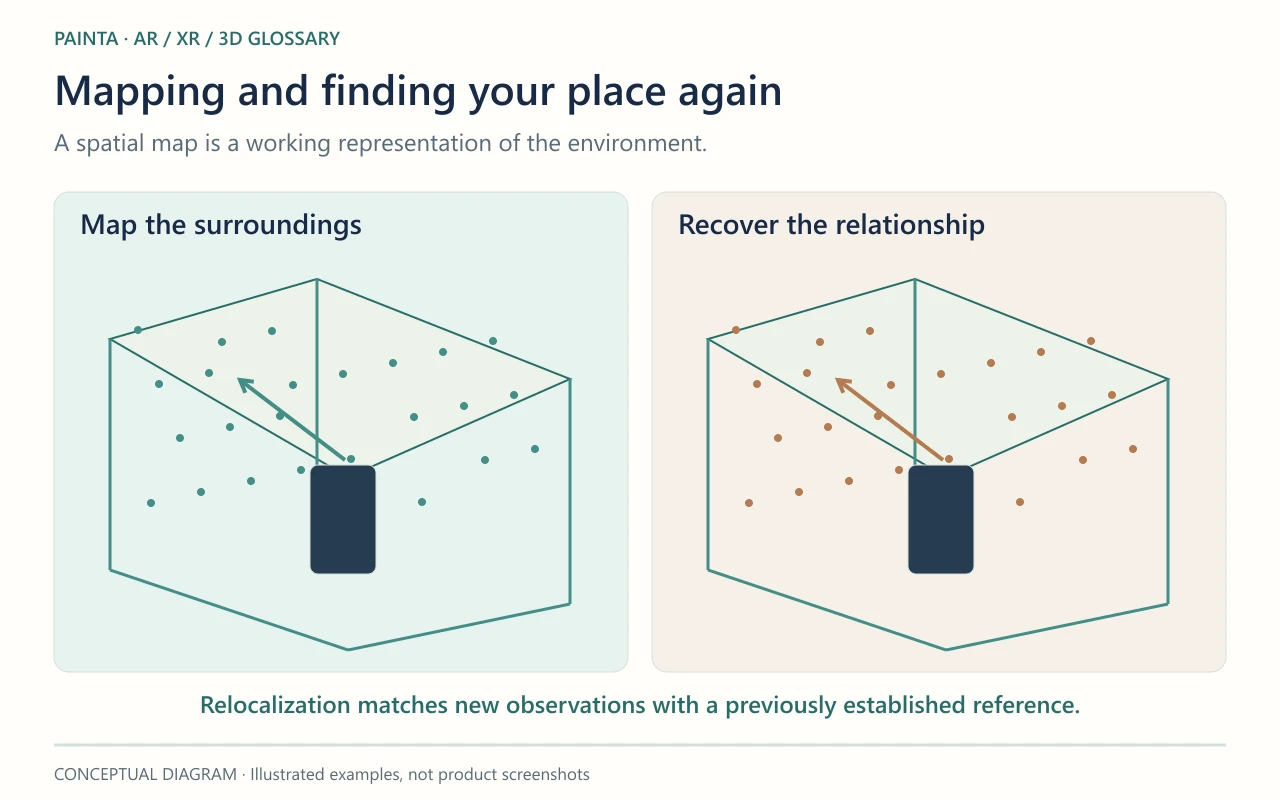
Relocalization is the process of finding a device’s pose again within a previously established spatial map or reference.
Finding the relationship again
Tracking may be interrupted when a camera is covered or an application is paused. A spatial system can try to match newly observed features with an existing map to recover the relationship between the device and that space. Some systems also use relocalization when loading a saved map or joining a shared experience.
Recovery is not guaranteed
A room that has changed, a different viewpoint or poor lighting can make the match difficult. Relocalization may take time or fail. Saving an anchor does not by itself ensure that another device can resolve it later; persistence, map sharing and permissions depend on the platform. A scene that seems stable during one session is therefore not proof of reliable return visits.
An exhibition needs a recovery experience
For a spatial installation, explain what the visitor should do if alignment is lost, such as looking back toward a recognised area. In a Painta project, use the recovery behaviour supported by the actual tracking mode rather than assuming all forms of AR share maps. Test interruptions deliberately at the venue, including walking away and returning, before relying on persistent placement in the visitor journey.
Related concepts and further reading
Apple: relocalizing a shared AR world map
Compare this recovery process with tracking drift, where the estimated placement gradually loses alignment over time.