Spatial mapping builds a digital representation of the surrounding physical environment for use by a spatial application.
A working model of the room
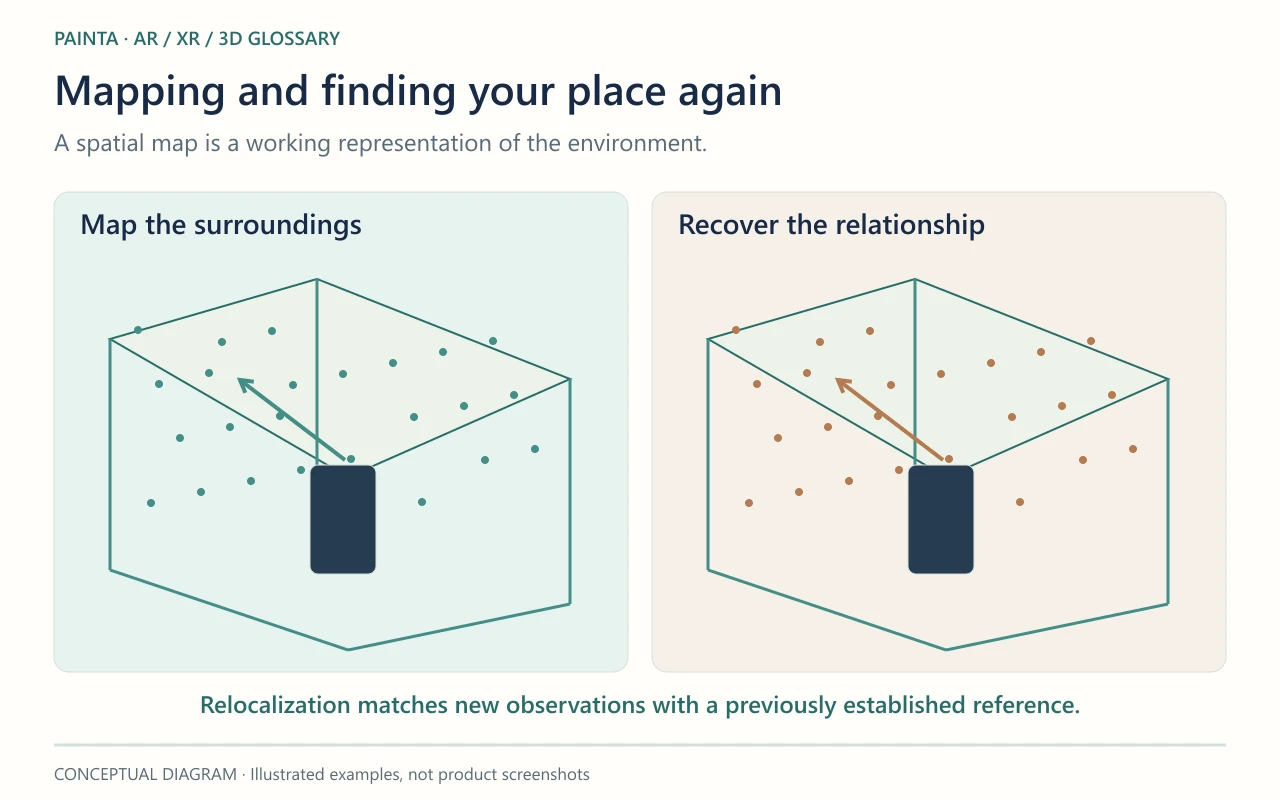
Depending on the system, the representation may include surface meshes, planes, feature points or other information. It can help an application reason about where content belongs or where real surfaces might block it. The map is an estimate that develops as the environment is observed. Unseen, reflective, thin or moving objects can be difficult to represent reliably.
A tracking map is not an archival scan
A map made to support interaction can have holes, simplified geometry and little or no photographic appearance. A museum-quality digital replica has a different purpose and may require a separate capture and documentation process. Likewise, having a map does not automatically enable collision, occlusion or persistence: the application must use the available data for those behaviours.
Plan only the spatial features the work needs
For a Painta exhibition concept, decide whether the room itself needs to participate or whether a recognised artwork provides a sufficient reference. A room-aware installation requires testing under the venue’s lighting and visitor conditions, with a supported runtime. The illustration deliberately contrasts a simplified room map with a flat placement plane; neither should be mistaken for a finished 3D reconstruction.