The "Wild West" days are over. Here is the math behind profitable Augmented Reality art.
The biggest secret in the AR creator economy isn't a new software feature; it's the fact that nobody knows how to price their work. If you ask three different creators how much they charge for an AR layer on a painting, you’ll get three answers ranging from "I do it for exposure" to "5000€ per piece."
A useful quote separates creative work, the platform plan and any ongoing care. The calculations below are examples for building your own quote, not a market survey or a compulsory price list. Painta's own services have specific scopes, which are listed separately below.
Painta Plans and Preparation Services
Prices checked on 21 September 2026: Free is €0/month, Creator Hub is €12/month and Studio Pro is €45/month. Free includes unlimited artworks, with editing limited to the three most recent, 1 GB per artwork and a standard watermark. Creator Hub removes the watermark and the three-work editing restriction. Studio Pro includes unlimited AR Collections, with up to 120 artworks per collection behind one shared QR. See the current pricing and plan details before confirming a quote.
Artwork setup: €149 one-time for one artwork using your finished video or audio, including AR setup, a QR code, agreed mobile checks and one round of minor adjustments. Animation creation is a separate service.
Animation and setup: from €390 one-time for one simple 2D animation of up to 15 seconds and its AR setup. You provide the story and creative direction; the package includes a preview, agreed mobile checks and one round of minor adjustments. The final price is confirmed after reviewing the idea. This limited scope is different from commissioning research, a script, original voiceover and a longer animation.
Exhibition setup: €449 one-time for up to five artworks using your finished videos or audio, with individual QR codes and digital wall labels from a shared template. It includes a written setup guide, agreed checks and one shared revision round. It does not include creating the animations, printing or on-site installation. A collection with one shared QR requires Studio Pro.
These preparation services are separate from your Painta plan, hosting and any Legacy Mode licence. Extra work and changes of direction are quoted separately. Legacy Mode is a separate self-hosted viewer download, with a one-time licence starting at €50 per artwork and no Painta subscription required for the exported viewer; arrange its hosting and ongoing care separately.
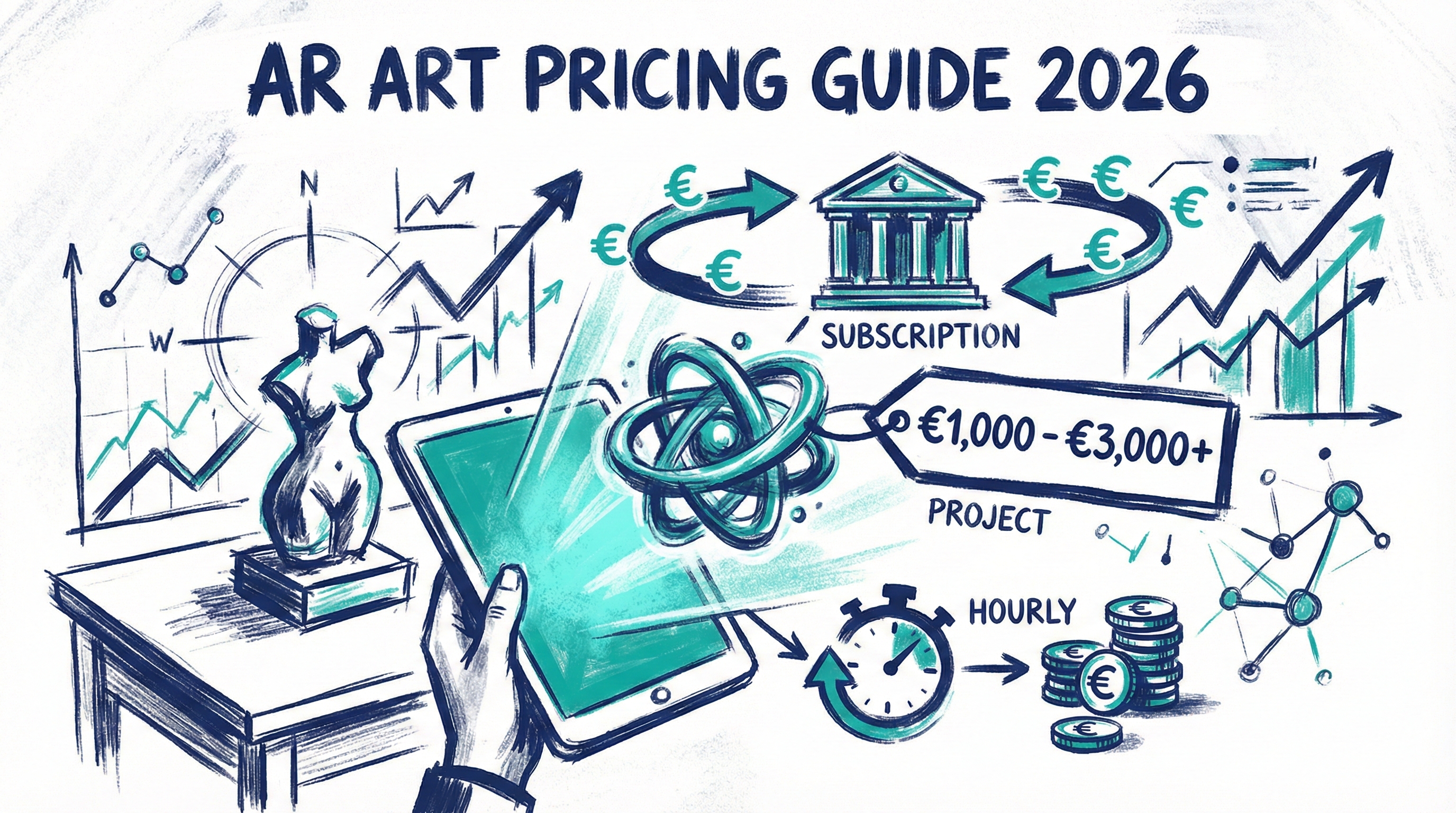
The Hourly Rate Model
The Baseline Best for: Freelancers starting out or small, one-off adjustments.
Start by estimating the work your brief actually requires. For this example, allow 8 hours for scripting, audio preparation, a simple 2D animation and AR setup. This is a planning assumption, not a standard production time: supplied media, revisions and complexity can change it substantially.
The example rate: €50 per hour. Choose your own rate from your costs, experience and the scope of the assignment; this figure is not a verified industry average.
The Math: 8 hours x 50€ = 400€ base labor cost.
Complete the quote: add the project's share of platform fees, licensed assets, revisions and other agreed costs, plus your margin. Allocate recurring software costs over the relevant period and projects. Check the current Painta plans and state whether the client pays the subscription directly or reimburses you.
Example quote: €500–€600 could fit the 8-hour scenario above if the remaining costs and margin fit that budget. It is not a minimum price for every AR artwork. A shorter, tightly scoped animation or setup using finished media can cost less; a larger brief can cost more.
The Project-Based Model
Selling a defined result works well for complex animations and institutional clients. Agree the duration, media, creative direction, revisions, rights and delivery checks before quoting. A custom commission that includes research, scripting or sound production has a different scope from setting up media the client has already finished.
Illustrative project ranges, to be checked against your own time and costs:
Focused 2D project (€500–€600 in this example): A simple animation and AR setup with a defined amount of scripting or audio preparation, as in the 8-hour calculation above. Specify exactly what the client supplies and what you create.
Expanded project (€600–€1,200 as an example): More motion design, sound work or interaction, priced from the agreed deliverables. This is an illustrative quote range, not an established gallery rate.
Custom project (an illustrative €1,200 or more): Bespoke 3D work, additional scenes or more involved interaction may require a larger budget and a feasibility review. Neither a high-profile venue nor a larger audience automatically requires this production tier.
Ongoing Care and Service Retainers
A museum, heritage site or long-running exhibition may need someone to review content, help staff and check the experience during the agreed display period. Estimate that work separately from initial production and from the platform subscription.
Usage terms vary by provider. If a platform charges for views or scans, identify the actual allowance and overage policy before quoting it. Painta's published pricing currently lists no per-view tariff or scan-overage fee. Do not add those charges to a Painta quote by assumption, or treat their absence as a capacity guarantee for a large event.
Offer a retainer when there is defined ongoing work. Specify the review frequency, included adjustments, response arrangements and duration. A small one-off setup does not automatically need a maintenance contract, and help with Painta product bugs remains part of product support.
For a collection, quote the actual research, media production, setup and agreed testing first. Add a monthly or annual service fee only for the ongoing work the client has chosen. There is no universal €2,500–€10,000 setup requirement: preparing finished media for a small exhibition is a different job from producing an original museum narrative.
B2C vs. B2B: Know Your Customer
The pricing psychology changes entirely depending on who pays the bill.
Scenario A: The "Phygital" Sale (B2C / Artist Direct) You are selling a physical painting that comes with an AR layer.
Strategy: The AR is a value-add that justifies a higher price tag for the physical piece. It differentiates your work in a crowded market.
Pricing: You don't line-item the AR. Instead, the artwork price increases to reflect the dual nature of the piece (Physical + Digital Asset). It validates the artwork as a contemporary, tech-forward investment.
Scenario B: The Service Provider (B2B / Gallery Services) You are hired by a gallery to animate their artists' work.
Strategy: You are a production studio. Your value proposition is sales conversion. You help the gallery sell more art by allowing collectors to "visualize" pieces in their homes or by creating buzz-worthy viral content for exhibitions.
Pricing: Quote per piece or offer a volume price when shared work reduces your costs. For example, ten custom works quoted at €600 each would total €6,000; this is a hypothetical production estimate, not Painta's exhibition setup package. Specify who owns the digital material, who pays for the plan and what happens after delivery.
Painta's advice
In 2026, AR is no longer a gimmick; it is a communication channel. Whether you are using WebAR or WebXR, or preparing for Android XR, the market is ready to pay for quality. Move away from hourly billing and start charging for the immersive value you create.