Splats, photogrammetry or 3D models: what should you choose?
person
Painta.me
Sep 27, 20266 min read
A gallery wants collectors to see a sculpture in their own rooms. A curator wants to preserve the atmosphere of an installation. A museum educator wants to show how a historical object opened, moved or fitted together. All three briefs may arrive with the same request: “We need a 3D version.”
Yet each calls for a different kind of asset. The first needs a convincing object at the right scale. The second depends on relationships within a space. The third needs a structure that can support a particular explanation.
Choosing between Gaussian splats, photogrammetry and a model built by an artist becomes easier when you begin with what the audience should be able to do. That choice also affects the commissioning brief, the files you keep and the amount of work needed after capture.
Photo: Painta.me · Original AI-generated editorial illustration
Separate the method from the file you receive
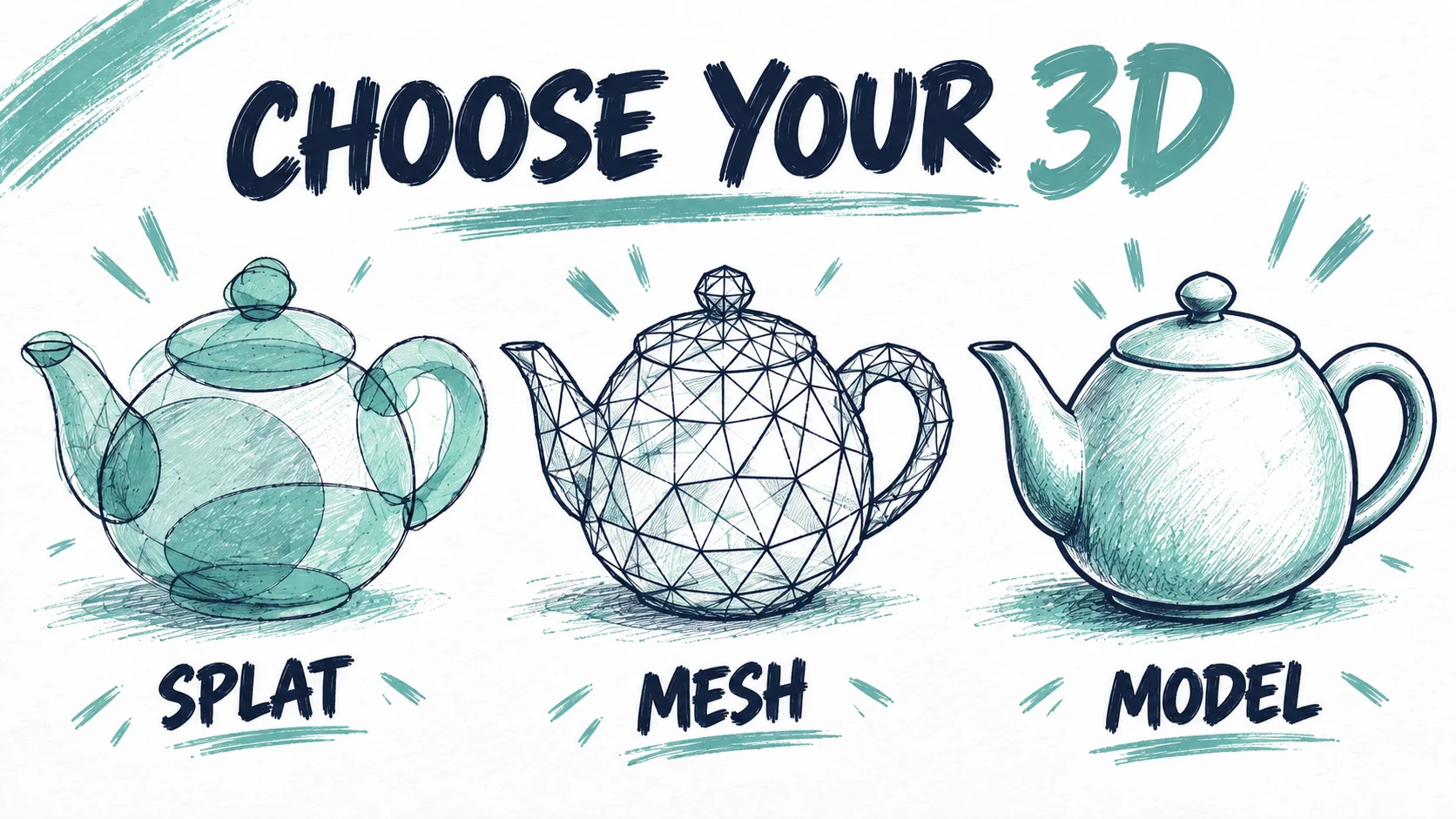
Photogrammetry is a reconstruction method. It uses overlapping photographs taken from different viewpoints to derive a three-dimensional representation. Apple's Object Capture documentation offers one clear example of this process. Other tools have their own workflows and outputs.
A mesh describes surfaces through connected geometry. It may come from photogrammetry, another scanning process or manual modelling. It can be prepared with textures, materials and, where the project requires it, animation. “Scanned” and “modelled” therefore describe how work was produced, not two file types that can never meet.
A Gaussian splat is another representation, focused on reconstructing appearance from views. Our introduction to Gaussian splatting for art and museums explores why that can be so effective for places and installations.
GLB, meanwhile, is a way of packaging glTF content. Khronos describes glTF as a delivery format for 3D scenes and models, including geometry, materials and animation. It is useful to ask for a compatible delivery file, but “send a GLB” does not specify the quality, behaviour or supported extensions of the asset inside. Khronos glTF overview.
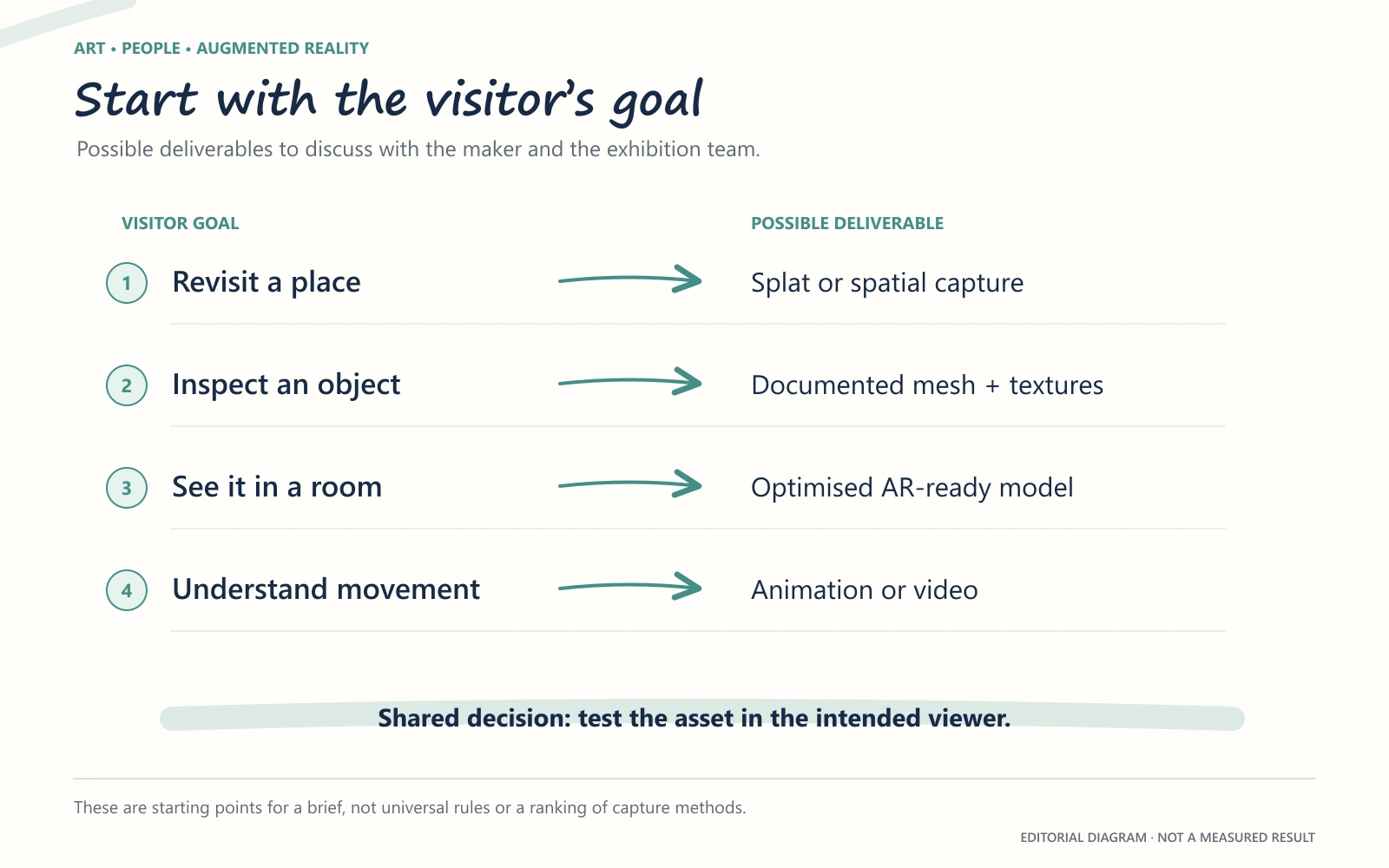
Begin with the encounter you want to support. Capture methods and delivery formats are choices to evaluate, not interchangeable labels.
If the goal is to revisit a place
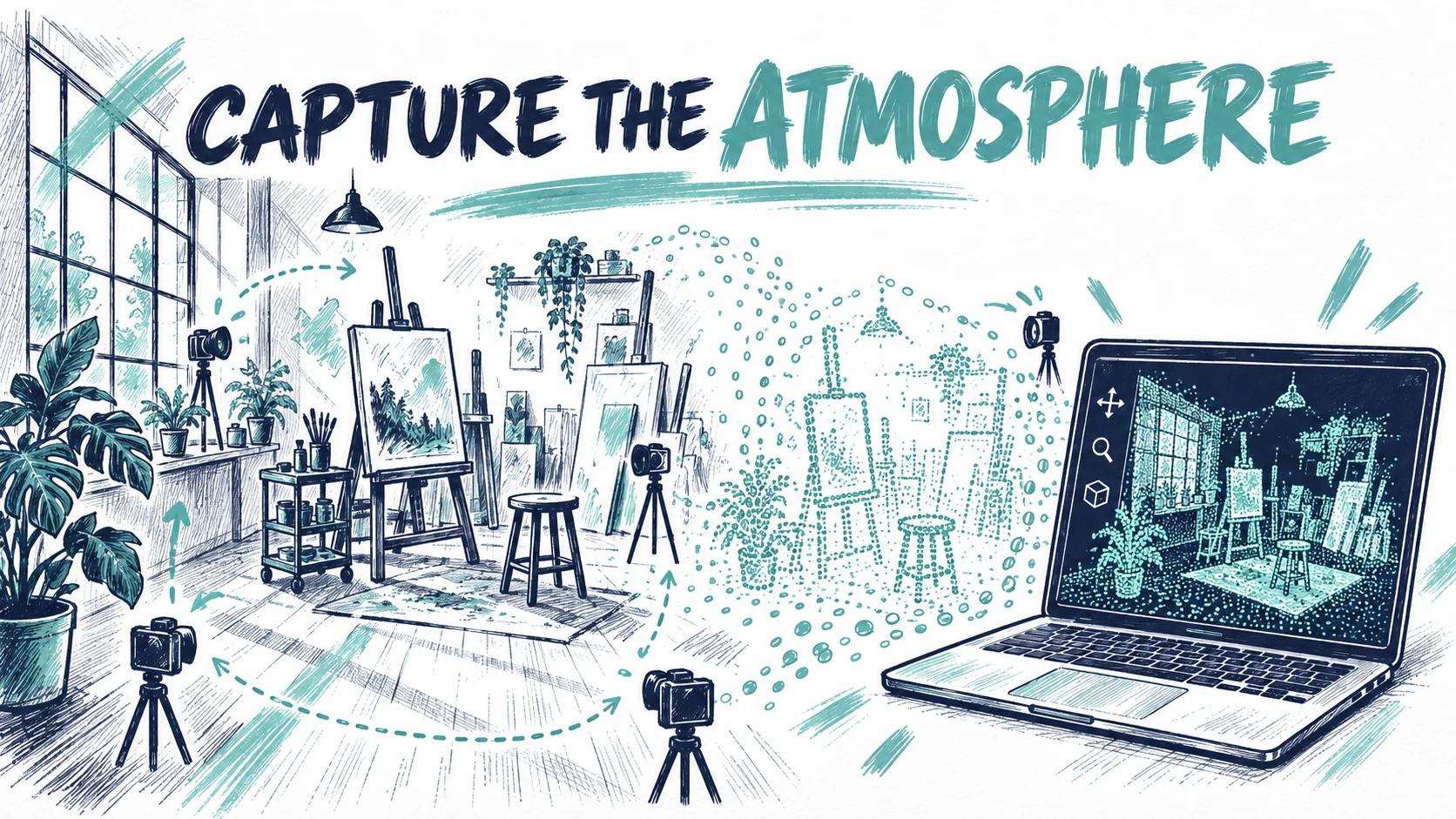
Suppose an artist has arranged drawings, found objects and small lights across a room. The arrangement itself matters. A spatial capture is a reasonable option to investigate because the visitor needs to understand the work from several positions.
Before commissioning, agree where viewers should be able to go. A short route through selected viewpoints is a different brief from unrestricted exploration. Establish which details carry meaning: an inscription on a wall, the distance between objects or the way one layer hides another.
Request a sample that includes the difficult part of the installation. A smooth empty wall tells you little about an area of thin wires and reflective objects. The sample should answer an artistic question: does the relationship that makes this installation work remain understandable?
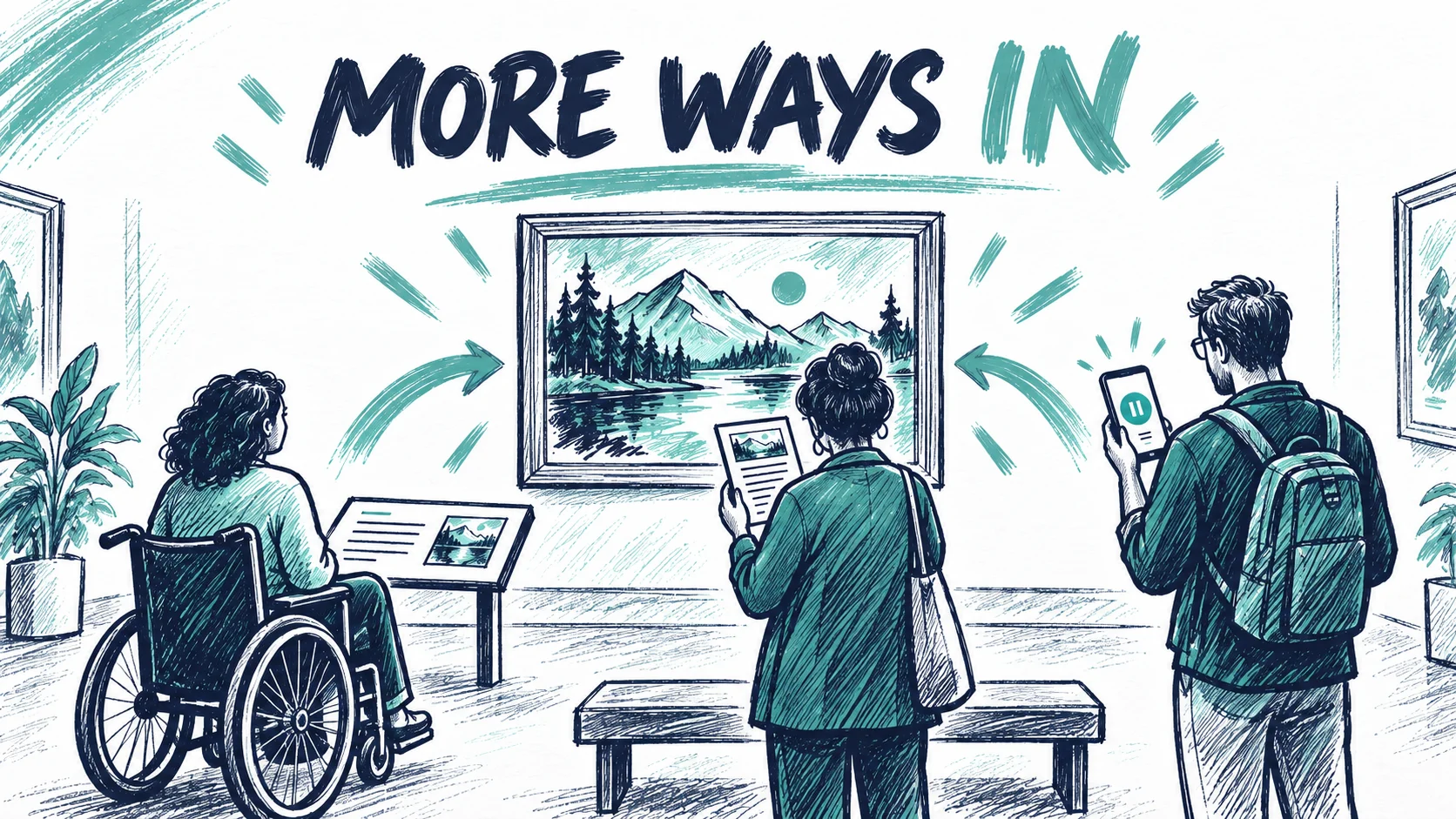
Think about the public presentation at the same time. A recorded voice could guide attention to one corner. A still photograph might show a detail more clearly. A short film can provide a route for someone who does not want to navigate a spatial scene. Commission these as related versions of the same story, with clear roles and shared context.
If the goal is to inspect or place an object
For a collector considering a sculpture, useful questions include its size, silhouette and relationship to the room. For a museum visitor, the point may be seeing the reverse of an object normally displayed against a wall. A prepared mesh is a practical candidate for both briefs.
Decide which views matter and confirm that they exist in the capture. If the underside cannot be recorded, the team should identify how that absence will be handled. A blank area, an explicit omission and an artist's reconstruction communicate different things.
Scale deserves its own acceptance check. Ask the producer to document the intended dimensions and verify them in the target viewing experience. A model that looks persuasive at the wrong size can undermine a collector's decision. For institutional work, any claim of measurement accuracy should have a defined method and evidence appropriate to the purpose.
Photogrammetry is one possible route, but it still needs object-specific judgement. A 2026 study by Carmeliti and Marziali compares reconstruction approaches across cultural heritage cases and frames accurate geometry and texture as distinct restoration needs. Its value for a commissioning team is the reminder to evaluate the object and intended use, rather than assume a single method will win every comparison.
For a delicate or protected object, the capture plan also belongs with the people responsible for its care. General scanning advice about moving, coating or preparing a surface should never become an automatic instruction for a collection item.
If the goal is to explain change or movement
A digital copy of an object does not automatically explain how it worked. Consider a historical box with a hidden compartment. The educational experience might need separate components, controlled movement and a clear view into its interior.
That brief calls for deliberate modelling and animation decisions. The team may use photographs and a scan as evidence, then build the structure needed for the explanation. An artist creating a fictional transformation can make different choices, but still benefits from planning which parts move and why.
Specify what is documented and what is interpreted. A visitor should be able to distinguish a recorded mechanism from a plausible reconstruction. If evidence is incomplete, the uncertainty can become part of the story: two proposed arrangements may be more informative than one confidently presented guess.
This is where a commissioning conversation becomes more productive than a feature checklist. “Show how the lid reveals the hidden drawing” gives a producer a clear result to design. “Make it interactive” leaves the central editorial decision unresolved.
Conversion helps, but it does not finish the brief
Questions about turning splats into meshes appear regularly in specialist communities, including this GaussianSplatting discussion. It reflects a real need for reusable assets, although individual forum experiences are not a current compatibility guide.
Tools have moved on. Polycam now advertises mesh downloads alongside Gaussian splat capture, while its export documentation distinguishes available splat artefacts from exports that require mesh data. Check the capture type, plan and actual output. Polycam splat capture, export documentation.
Treat a converted result as another deliverable to review. Does it preserve the edges that matter? Are textures complete from the intended viewpoints? Can the next artist make the required changes? If a component must open or bend, has the asset been prepared for that behaviour?
Keep the source material and editable project as well as the public delivery file. Record permissions for the object, the capture and any commissioned creative work. Agree who can revise the asset and where it may appear. Our article on AR art conservation strategies considers the longer life of this work beyond its first presentation.
For Painta, a prepared GLB can sit alongside image, video and audio layers in an artwork's story. A native splat needs separately verified playback support. Bring one representative asset into the intended experience early, before commissioning the rest of a collection. That small test can establish a much clearer brief for your next project.
Founder and creator of Painta.me. Artist in my spare time and AR art enthusiast. Building tools to help artists bring their creations to life through augmented reality.
A short weekly email with new Painta.me tools, practical AR ideas, artist opportunities, and ways to make your work easier to create, publish, and share. Useful even if you haven't created your first piece yet.
What you'll get
1
New AR tools
See what's new inside Painta.me and how it can help you create faster.
2
Artist opportunities
Open calls, featured works, community updates, and ways to get your art seen.
3
Practical AR ideas
Simple techniques to create, publish, and share better augmented reality pieces.
auto_awesome
Ready to create?
Create your free account, prepare an artwork and share it in augmented reality. Choose a paid plan when you need more.