Gaussian splatting for art and museums: a sense of place
person
Painta.me
Sep 23, 20266 min read
An exhibition ends in stages. The visitors leave, the labels come down, the works go into crates. A few days later, the photographs remain, but the relationships between things are harder to recover: the view from the doorway, a sculpture catching the window light, the small painting that only became visible as you turned a corner.
Gaussian splatting offers an intriguing way to keep something of that spatial experience. For artists and museums, its appeal lies in the possibility of revisiting the appearance of a place from more than one fixed viewpoint. A studio can retain its clutter and atmosphere; an installation can remain legible as a composition in a room.
That promise deserves a careful explanation. A beautiful spatial capture has several possible uses, and each asks something different of the result.
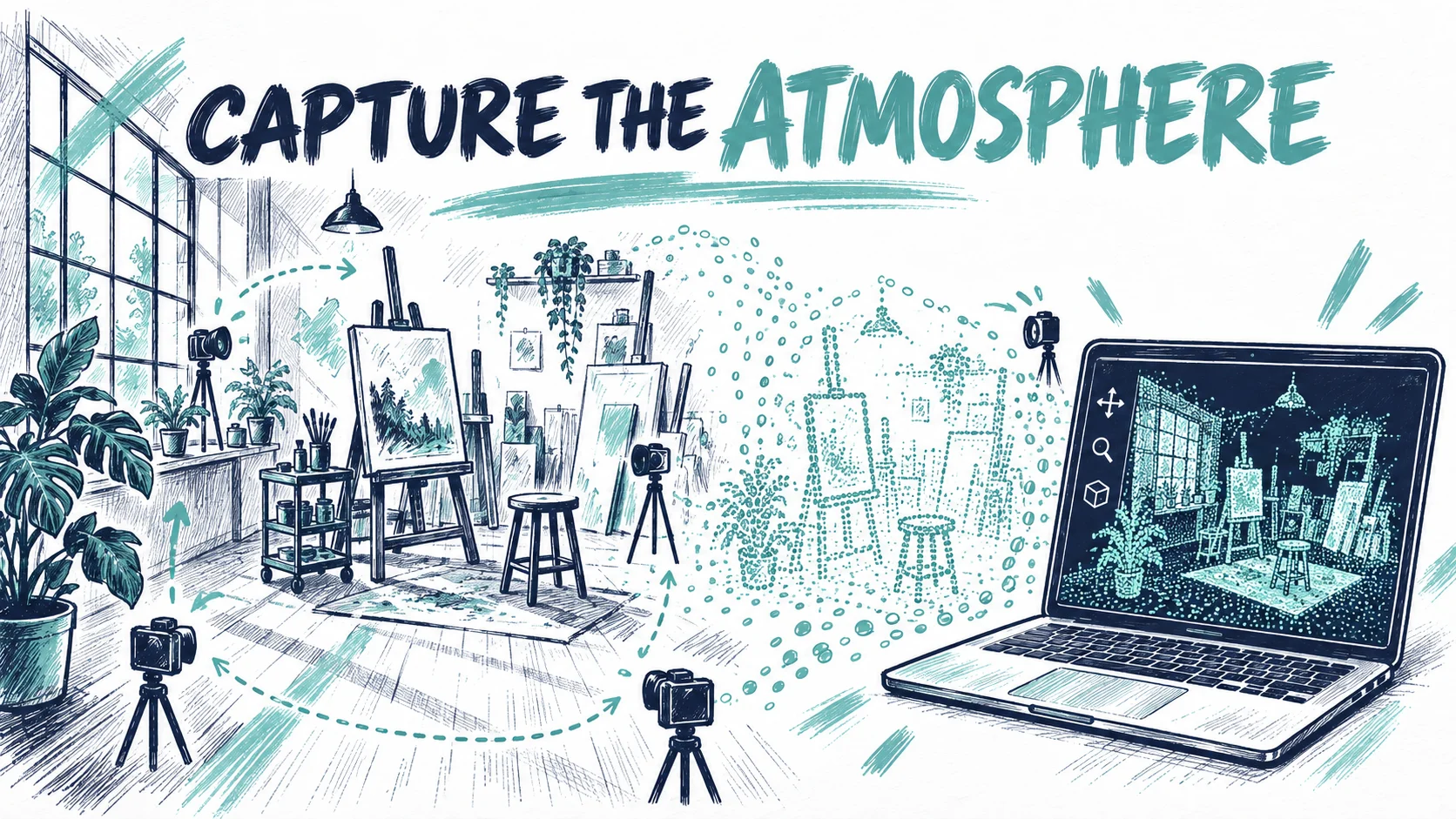
Photo: Painta.me · Original AI-generated editorial illustration
What a Gaussian splat actually preserves
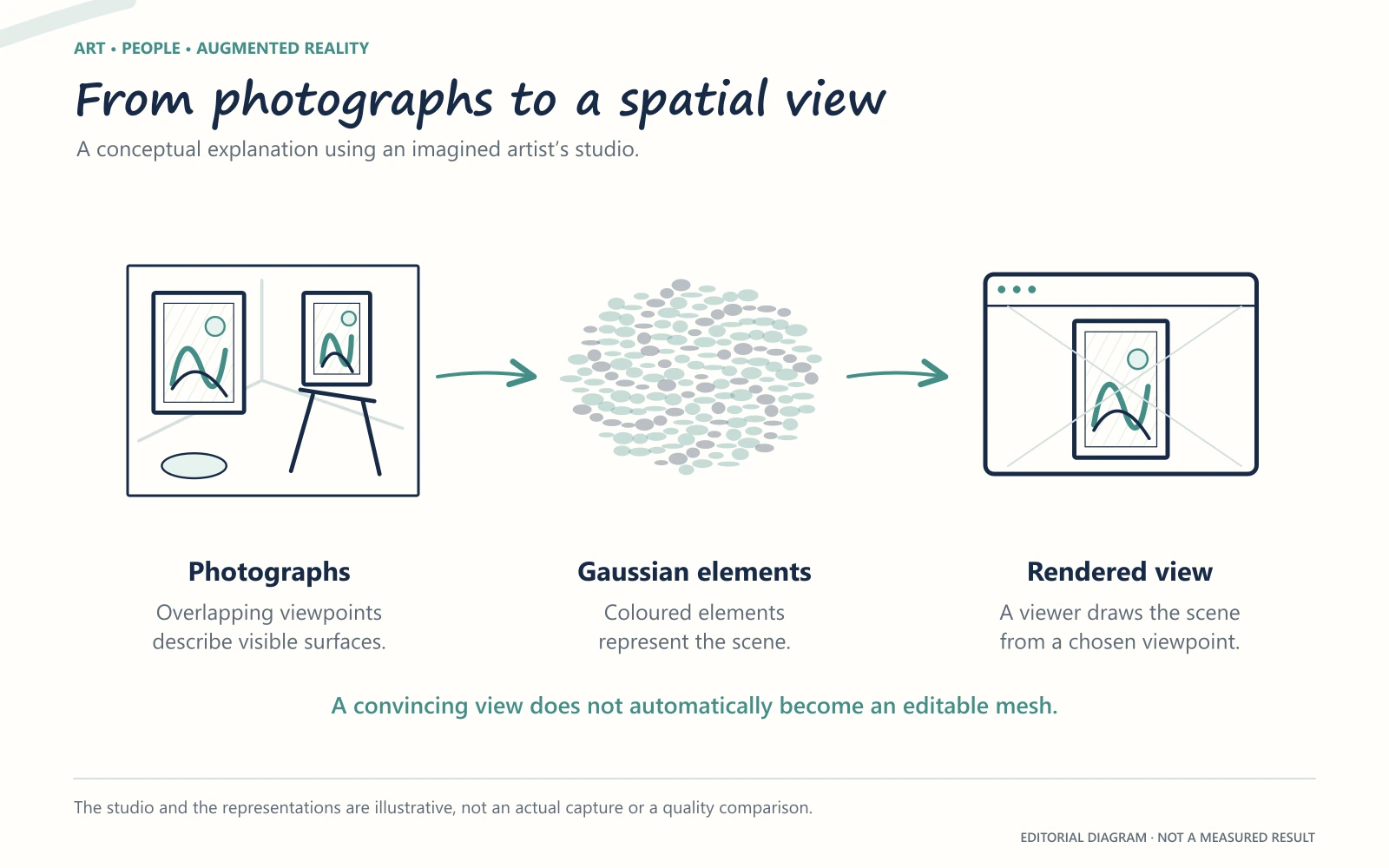
Imagine a photograph you can move a little way into. That is a useful first impression of a Gaussian splat, although the underlying process is more involved. Multiple photographs or video frames provide different views of a scene. The reconstruction represents its appearance through many small, overlapping Gaussian elements, each with properties such as position, size, opacity and colour.
The renderer combines those elements to produce a view from a chosen position. The influential 2023 Gaussian splatting paper demonstrated an effective approach to this kind of scene reconstruction and rendering. Its reported performance belongs to its own tests; it should not be read as a promise for a museum visitor's phone.
For a curator, the interesting consequence is spatial continuity. Consider a hypothetical installation built from translucent fabric, hanging drawings and projected light. A conventional photograph makes a strong record of one composition. A spatial capture could help a remote viewer understand how the layers relate as their viewpoint changes.
This is also a creative opportunity. An artist could use a captured room as the setting for a recorded recollection, or contrast an installation before and after its audience has moved through it. The capture becomes part of the work's language, with its own framing, omissions and point of view.
Gaussian splatting can create a spatial representation from photographs. This diagram explains the idea; it is not a measured capture comparison.
Why the results can feel unusually alive
Some spaces resist a tidy description. The character of a workshop may sit in a crowded shelf, thin chair legs, reflections and uneven light. A capture that retains enough of those visual relationships can feel familiar even before you identify each object.
That suggests an editorial role for Gaussian splatting: invite someone into the circumstances around a work. Instead of adding another paragraph about an artist's process, a gallery could commission a short spatial visit to a particular corner of the studio, accompanied by the artist's own account. The text supplies context; the captured space gives the account somewhere to happen.
A museum could explore a similarly focused use for a temporary exhibition. Rather than attempting an unlimited virtual visit, it might preserve three viewpoints that explain a curatorial choice. Why were these objects placed together? What did a visitor encounter first? What becomes visible from the side?
These are proposed uses, not automatic benefits of the technology. A capture with no route, interpretation or reason to linger can leave a visitor unsure what to look at. The creative task remains selecting what matters and giving the viewer permission to spend time with it.
The visible scene and the physical object are different records
The distinction becomes especially important around collections. A convincing image can encourage us to assume that everything we see has been recorded equally well. In practice, what was photographed, from which positions and under what conditions still shapes the result.
A 2026 heritage study using consumer-grade capture discusses limits caused by incomplete visual evidence, including difficult edges and shadowed areas. It also highlights a curatorial problem: measured evidence and reconstruction are not automatically apparent to the viewer.
Suppose the back of a sculpture was inaccessible during capture. An attractive frontal view does not establish what is on the hidden side. If an artist deliberately completes that side, the intervention can have value, but the presentation should identify it. If a conservation team needs measurements or condition evidence, its requirements must guide a separately validated recording process.
Keep the original photographs, acquisition notes and a record of significant edits alongside the public-facing result. Explain whether the experience shows a documented state, a reconstruction or an artistic interpretation. These simple distinctions give future curators something they can assess and help visitors understand what they are seeing.
The broader question of keeping digital works usable belongs to AR art conservation too. A compelling presentation and a durable archive are related responsibilities, with different deliverables.
Getting a splat onto the web takes another decision
The capture is only part of the experience. A visitor also needs to load it, understand the controls and view it comfortably on the device available to them.
Specialist web tools are developing quickly. PlayCanvas documents several splat formats and an approach to streaming different levels of detail. Those tools make web delivery a practical area to explore, but performance depends on the scene, its preparation and the viewing device.
There is also progress toward interchange. As checked on 20 September 2026, Khronos marks its Gaussian splatting extension for glTF as ratified. This allows splat data within glTF assets; a viewer still needs to implement the extension. The familiar file family is not sufficient evidence that a particular platform will display the capture correctly.
For a public commission, ask to see the actual delivery experience on an ordinary phone before signing off the capture. A useful review includes a cold load, a slow connection and a person who has never seen the controls. These are proposed acceptance checks, not reasons to strip every scene of richness. They help decide where that richness is most valuable.
Give the capture a place in the story
A splat can be the centre of an artwork, one part of a larger exhibition record or a reference for another production. Its role should be clear enough that someone can explain why a visitor would open it.
For a Painta experience, the surrounding story can use supported image, video, audio and GLB layers. A rendered film or selected still from a spatial capture may serve a particular narrative moment, while an interactive splat requires a compatible specialist viewer. Native splat playback should be confirmed separately rather than assumed from general 3D support.
The choice of display follows the same principle. Our comparison of XR glasses for AR art looks at the difference between a spatial screen and an experience placed around a visitor. Decide what someone should be able to notice before deciding what they should wear.
Start with a place whose disappearance would leave a gap: a studio arrangement, a temporary installation, a corner where two works unexpectedly speak to each other. Then decide how much of that encounter needs to remain interactive and how much can be carried by an image, a voice or a film. That is a useful brief to bring into your first Painta project.
Founder and creator of Painta.me. Artist in my spare time and AR art enthusiast. Building tools to help artists bring their creations to life through augmented reality.
A short weekly email with new Painta.me tools, practical AR ideas, artist opportunities, and ways to make your work easier to create, publish, and share. Useful even if you haven't created your first piece yet.
What you'll get
1
New AR tools
See what's new inside Painta.me and how it can help you create faster.
2
Artist opportunities
Open calls, featured works, community updates, and ways to get your art seen.
3
Practical AR ideas
Simple techniques to create, publish, and share better augmented reality pieces.
auto_awesome
Ready to create?
Create your free account, prepare an artwork and share it in augmented reality. Choose a paid plan when you need more.