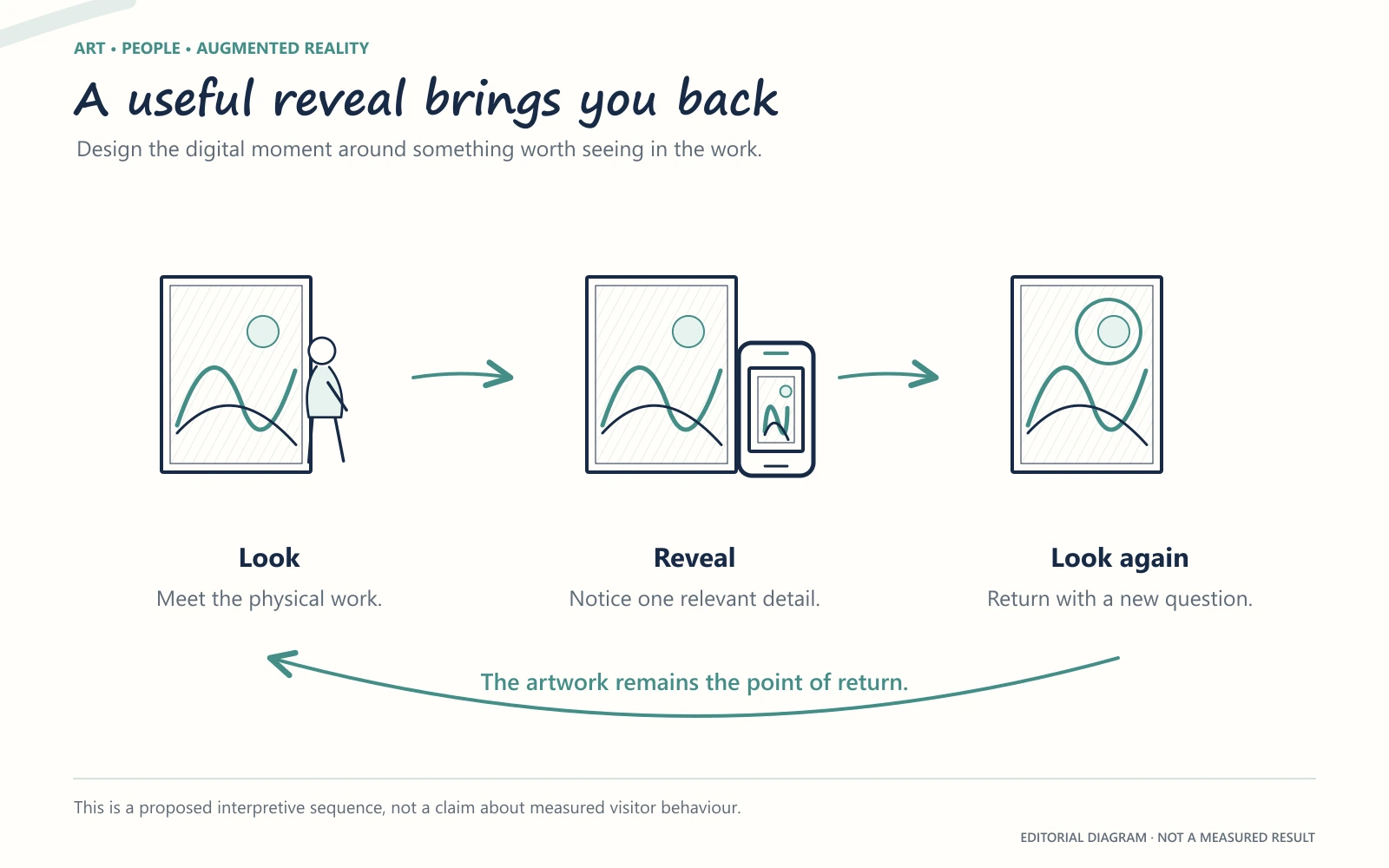
Imagine a visitor lifting a phone towards a painting. A line appears, tracing the direction of a figure's gaze. Another detail becomes visible: a small object on a table, easy to miss from a few steps away. Then the visitor lowers the phone and looks again.
That last movement is a useful ambition for museum augmented reality. The screen has helped someone find their way back to the work.
There are other worthwhile ambitions, of course. An artist might want a digital presence to become an essential part of a piece. A curator might need to explain a lost architectural setting. But the same question follows: what does this particular encounter make possible, and why does it belong here?
Photo: Painta.me · Original AI-generated editorial illustration
It is a better starting point than deciding that an exhibition needs an immersive feature.
Three different reasons to use AR
At National Gallery Singapore, Ngoc Nau's Fields of Light (AR) extended a projection on the building's facade into experiences at two locations inside the gallery. The programme ran from 9 to 31 January 2026. Here, AR belonged to an artist's developing visual language, connecting different parts of the exhibition through the work itself. The gallery's description traces the relationship between the projection and its AR extension.
A different intention shaped Riddle Mia This. When the Minneapolis Institute of Art announced the app in 2018, it described twelve puzzles leading visitors through artworks and gallery spaces. AR helped structure a search. The point was to notice something in the collection that could move the puzzle forward. This is a documented historical example; the launch announcement does not establish its present availability.
The Smithsonian's Skin & Bones, introduced in 2015, addressed another interpretive problem: a skeleton cannot show its living animal's movement or appearance by itself. The museum's account describes digital additions to selected Bone Hall specimens. The subject gave the animation a reason to exist.
These projects share a medium, but they do different jobs. One extends an artwork, another invites exploration, and another explains a relationship between structure and life. That distinction matters when a museum or gallery begins its own conversation about AR.
The object should set the brief
Consider a hypothetical portrait with a letter folded into the sitter's hand. The exhibition team has several possibilities. A label could explain the letter's significance. A recording could introduce a disagreement between scholars. An aligned visual layer could help visitors distinguish a barely visible mark on the paper.
The strongest choice depends on what is difficult to communicate. If the interpretation consists of a paragraph, placing that paragraph on a moving screen may add little. If understanding depends on finding a particular part of the painting, a brief visual intervention may earn its place.
The object can also tell the team when to stop. A delicate exchange between two figures might need a quiet indication and a few words. A complex mechanism might benefit from movement. Neither requires the same pace or visual intensity as a contemporary work conceived around interruption and surprise.
For a curator, this means retaining editorial control over the experience's rhythm. The technology should make room for the uncertainty, restraint and specificity already present in the interpretation.
An AR sequence can be designed around a return to the physical artwork: look, reveal, look again.
The scepticism deserves a serious answer
In a June 2026 MuseumPros discussion, commenters raised familiar concerns: downloading another app, maintaining it, asking visitors to spend more time on screens, and buying technology without a clear interpretive purpose. Others saw value in optional layers that reveal something unavailable through the object alone.
Those comments are individual experiences and opinions, not a survey of the museum sector. They are still useful questions for a project brief.
An exhibition team should be able to describe the benefit without using the words “innovative”, “immersive” or “engaging”. Perhaps a visitor will understand why a figure looks upwards. Perhaps they will hear an artist explain a choice that cannot be seen. Perhaps they will recognise that a proposed reconstruction includes uncertainty.
If the team cannot explain that benefit in ordinary language, the content probably needs more thought before the visual effects need more polish.
Make room for the people around the phone
An AR experience happens in a room. A partner may be waiting beside the person holding the device. A child may want to see. A guide may be speaking. Another visitor may be trying to reach the label.
These relationships deserve a place in the concept. A short reveal that two people can discuss creates a different encounter from a long sequence that asks one person to stand still with an arm raised. A staff member demonstrating a work can provide a social introduction that a printed instruction cannot.
This does not make one format universally better. It makes the exhibition's circumstances part of the creative decision. A contemplative installation, a busy temporary show and a small guided group each create a different setting for attention.
Headsets change those circumstances again. Our discussion of XR glasses for viewing AR art explores that choice. Choosing the device comes after understanding the encounter you want to support.
Decide what a worthwhile result would look like
It is tempting to treat every scan as a successful interaction. A scan can show that someone found the invitation. It cannot, by itself, show what they understood.
For a small pilot, a more revealing question might be: can visitors now point to the detail the experience was intended to explain? Do they talk about the work afterwards? Do they understand which parts of a reconstruction are interpretive? These are proposed evaluation questions, not outcomes established for the examples above.
Observing a handful of encounters can also expose ordinary problems: an unclear instruction, a queue in the wrong place, or a scene that ends before someone has found the relevant detail. The aim is to learn enough to revise the experience, with room for visitors whose preferences differ from the team's.
Maintenance belongs in that conversation too. An interpretive layer needs someone to check its content and delivery after opening. Our article on conserving AR artworks considers the longer life of that commitment.
Begin with an artwork you can speak about precisely
For an artist, gallery or museum considering Painta, one physical work with a clear interpretive opportunity is a manageable place to begin. Image, video, audio and suitable 3D layers offer different ways to develop that opportunity; a web QR entry point offers a route to encounter it. The content still needs the artist's judgment and, where appropriate, curatorial review.
The next conversation can be small and specific: this work, this detail, this audience, this reason for looking again. If that describes a project you are considering, explore Painta's options for exhibitions.
Founder and creator of Painta.me. Artist in my spare time and AR art enthusiast. Building tools to help artists bring their creations to life through augmented reality.
A short weekly email with new Painta.me tools, practical AR ideas, artist opportunities, and ways to make your work easier to create, publish, and share. Useful even if you haven't created your first piece yet.
What you'll get
1
New AR tools
See what's new inside Painta.me and how it can help you create faster.
2
Artist opportunities
Open calls, featured works, community updates, and ways to get your art seen.
3
Practical AR ideas
Simple techniques to create, publish, and share better augmented reality pieces.
auto_awesome
Ready to create?
Create your free account, prepare an artwork and share it in augmented reality. Choose a paid plan when you need more.