A digital sculpture turns on a screen. You can move beneath it, bring a small detail closer and examine a surface that would be difficult to see in a gallery. It feels wonderfully available.
Then a different question arrives. What, exactly, has been preserved?
The object's visible form is part of the answer. So are the choices made during capture, the areas the camera could reach, and the work done afterwards. The replica may communicate an extraordinary amount while still leaving out weight, material behaviour, history and the circumstances in which the original was encountered.
Photo: Painta.me · Original AI-generated editorial illustration
For artists and museums, that is a reason to describe digital replicas carefully. Their value becomes clearer when we understand the kind of record each one is.
A replica records an encounter with an object
It helps to imagine a specific commission. A museum wants a model of a carved panel. One purpose is to show visitors its relief. Another is to document surface condition. A third is to explain where the panel once sat in a building.
Those purposes overlap, but they ask different things of the material. A model designed for a phone may communicate the carving beautifully while being unsuitable for measuring a small change. A reconstruction of the building may help explain the panel's placement while including interpretive decisions that are absent from the captured surface.
Before calling the result a digital twin, the team should be able to explain which of these jobs it performs and which it does not. That explanation gives a future curator, researcher or artist a useful way to judge it.
Our comparison of splats, photogrammetry and 3D models looks at the different kinds of visual material involved. Here, the question is what those representations allow us to say about a work.
Looking convincing and carrying evidence are different qualities
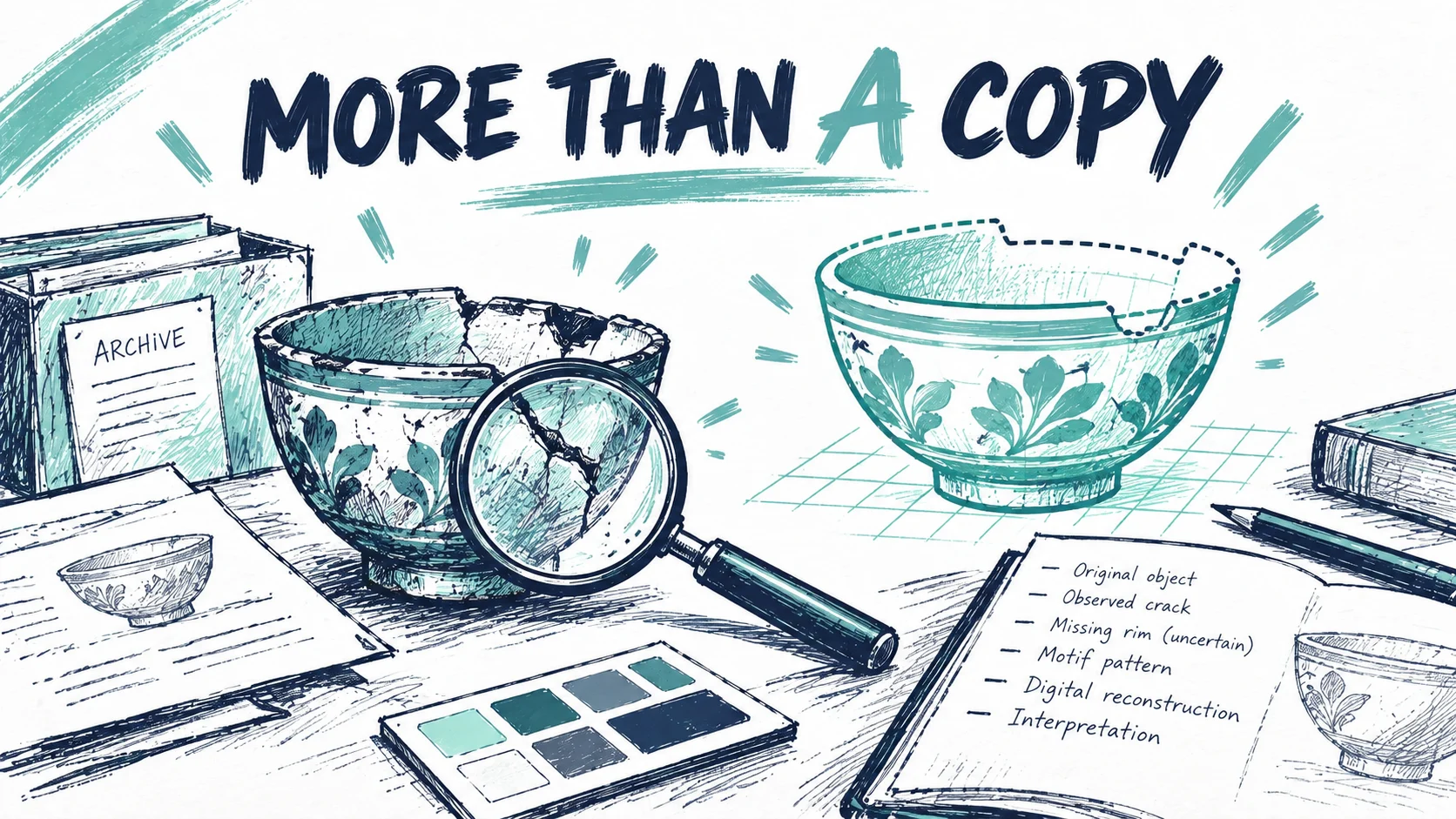
A smoothly finished reconstruction can appear more complete than the available evidence. A documented capture may contain gaps, awkward areas or surfaces that were difficult to record. Presentation quality and evidential value therefore need their own descriptions.
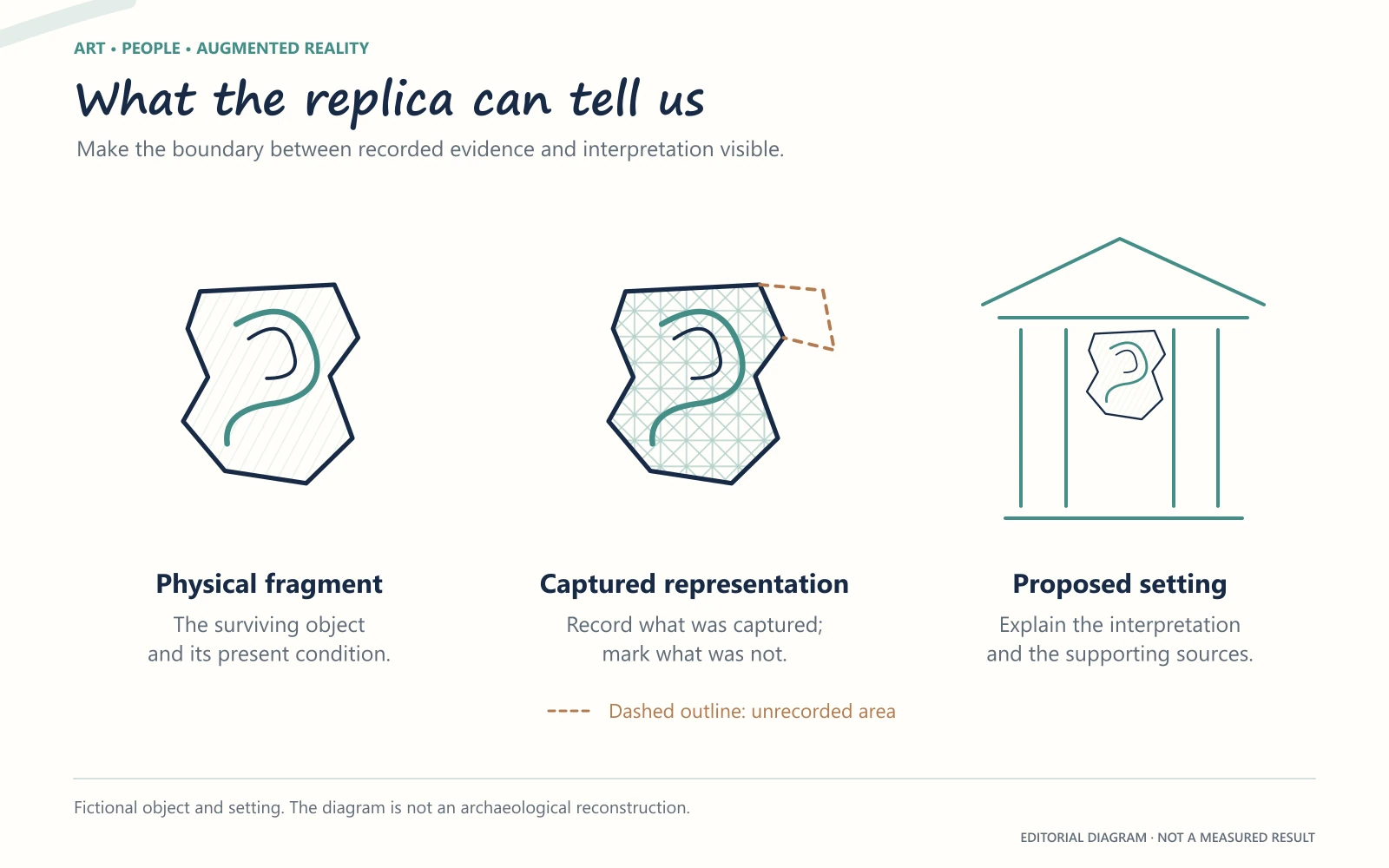
Imagine a vessel whose underside could not be photographed. If a modeller completes that area to make a tidy object for display, the result includes a decision. That decision may be sensible for the intended use. It should still be distinguishable from a surface that was recorded.
The same applies to reconstructed colour, a missing handle or a proposed architectural setting. A visitor should not have to know the production software to understand that some parts describe surviving evidence and others describe an interpretation.
This can be expressed with straightforward language. “Recorded surface” and “proposed reconstruction” tell a clearer story than an unqualified claim that an object has been restored digitally. Visual conventions can help too, provided a written explanation carries the same distinction.
A capture and a reconstruction answer different questions. Visitors should be able to distinguish recorded surfaces from proposed additions.
The account of how a model was made matters
The European cultural heritage project EUreka3D emphasised the relationship between 3D models, their descriptive records and paradata: information about the processes used to create the digital material. A Europeana Foundation account published in December 2024 describes this as part of the project's approach to making heritage models understandable and reusable.
The term can sound specialised. The underlying question is ordinary: what happened between the object and the file we are looking at?
For a small project, that conversation might include who captured the work, when it was captured, what could not be reached, what was altered and who reviewed the result. If the public version was simplified or adapted, a future user needs to know that it is a presentation version.
These records also make collaboration easier. The person writing the exhibition text can distinguish a production limitation from a historical absence. The artist can explain whether an irregularity is intentional. Someone revisiting the project later can understand why a choice was made instead of having to infer it from the final image.
Context may be the most valuable addition
The Met's Our First Virtual Worlds, announced in November 2025, describes experiences developed with Atopia around the Temple of Dendur and works from Oceania. They are browser and VR experiences, rather than on-site AR. Their interest extends beyond presenting rotatable objects: a visitor can encounter relationships and viewpoints unavailable in the physical galleries. The museum's account also identifies curatorial collaboration and contributions from Pacific Islander scholars and knowledge holders.
That distinction is important. A model can show where a surface lies. It cannot, by itself, establish what the object meant to the people who made or used it.
Interpretation needs voices, sources and choices about what deserves attention. Sometimes the useful addition is an explanation of scale. Sometimes it is a recording. Sometimes it is a clear account of how the museum's understanding has changed.
Getty's Persepolis Reimagined, introduced in April 2022, offers another example of connecting objects with a reconstructed setting. Its immersive website was developed with historians and museum specialists. It is an online interpretation of a place, not evidence that a digital representation can contain everything that place once was.
Some qualities remain outside the replica
An image of worn wood can communicate visible wear. It does not deliver the sensation of touching that wood. A model can be presented with dimensions, but the effect of sharing a room with a large object will also depend on how it is shown and experienced.
Time-based art adds another difficulty. Which moment is being recorded? A work involving an audience, changing light or a live performer has relationships that a single object file cannot explain. A carefully made recording can document aspects of the event, while an artist's account can explain which relationships are essential.
These limits need not make a digital encounter feel diminished. A replica can offer something particular and valuable: proximity to a detail, a comparison, a route into research, or a way for someone far away to begin a relationship with the work.
The more precise the promise, the easier it is to fulfil.
Give the public version a clear purpose
When a digital asset moves from a collections project into an exhibition, its purpose should travel with it. A small public scene might explain one feature of the carving. It need not carry every detail of the research record, but it should give a reader a path towards that record where appropriate.
For a Painta project, an optimised GLB model or an image, video or audio layer can become part of an AR interpretation alongside a physical work. That presentation is one use of the material. It is not a substitute for the collection's documentation or an assurance that every capture format, including native Gaussian splats, can be imported.
The longer-term care of the digital artwork is a related subject, covered in our article on AR art conservation. Before that work begins, the team needs a shared answer to a simpler question: what is this replica intended to preserve, explain or make available?
If you have an object or artwork whose story could benefit from a digital encounter, explore Painta's options for exhibitions. A clear purpose is the most useful thing to capture first.
Founder and creator of Painta.me. Artist in my spare time and AR art enthusiast. Building tools to help artists bring their creations to life through augmented reality.
A short weekly email with new Painta.me tools, practical AR ideas, artist opportunities, and ways to make your work easier to create, publish, and share. Useful even if you haven't created your first piece yet.
What you'll get
1
New AR tools
See what's new inside Painta.me and how it can help you create faster.
2
Artist opportunities
Open calls, featured works, community updates, and ways to get your art seen.
3
Practical AR ideas
Simple techniques to create, publish, and share better augmented reality pieces.
auto_awesome
Ready to create?
Create your free account, prepare an artwork and share it in augmented reality. Choose a paid plan when you need more.