Mesh compression encodes geometry data more compactly for storage or transmission, with decoding needed before the geometry is used.
Compression and simplification do different jobs
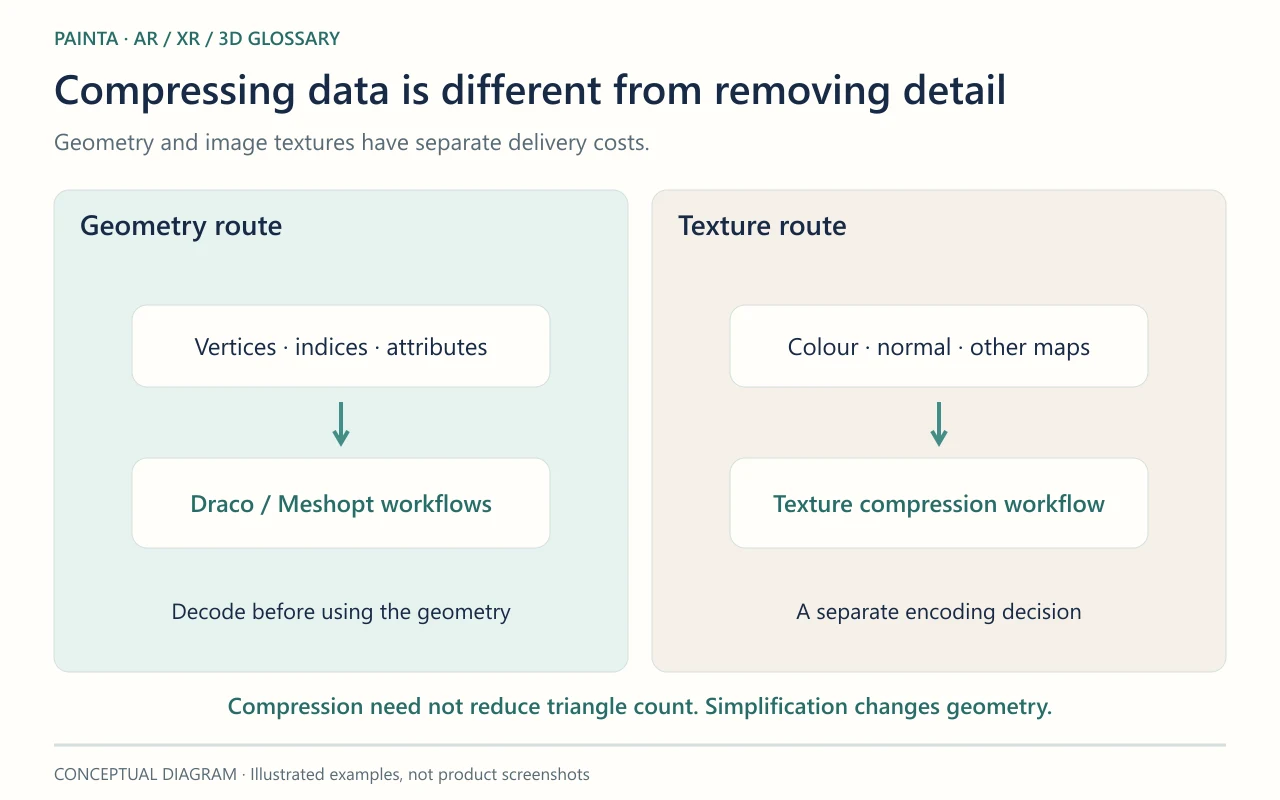
A detailed statue can retain its triangle count while its geometry is compressed into fewer bytes. Simplification instead removes or rearranges geometry to reduce complexity. An export pipeline can use both, but a smaller compressed file is not evidence that the model now contains fewer polygons or takes less work to shade.
Precision and compatibility are part of the choice
Compression workflows may quantize positions, normals or texture coordinates, storing them with reduced numeric precision. That can introduce visible changes even when the triangle count stays the same. Draco and Meshopt are common names in glTF workflows, and the viewer needs the appropriate support. Geometry compression also leaves a separate texture-size problem untouched.
Compare a recognisable contour
On an exported medallion, inspect the rim, raised lettering and UV seams. On an animated figure, check the full motion as well as the resting pose. Record download size and decode behaviour separately from sustained frame rate. Keep the original mesh and textures; a delivery file is a result to validate, not a replacement for the editable source.