glTF is a standard for delivering 3D scenes and models. GLB is its binary container, often used to package a model and its associated data into one file.
What a model can contain
A glTF asset can describe geometry, materials, textures, a scene hierarchy and supported animations. A .gltf file may reference separate files. A .glb file commonly packages the scene and its resources together, making it convenient to distribute.
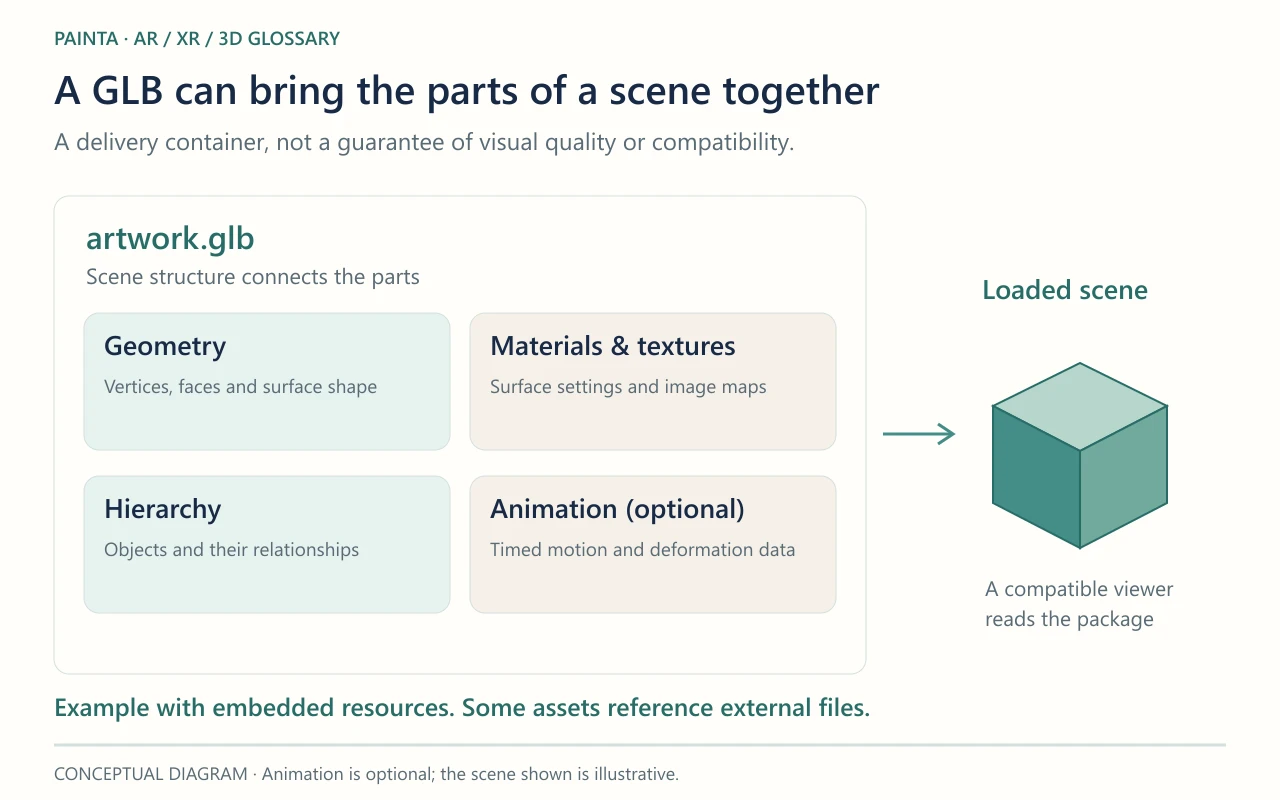
A delivery format, not a quality setting
Exporting to GLB does not automatically make an asset small, correctly scaled or compatible with every viewer. Large textures, complex geometry and unsupported extensions can still cause problems. Keep an editable source as well as the delivery file.
A Painta example
A prepared model can become part of an artwork's digital layer. Before publishing, inspect its orientation, scale, materials and animation in the actual viewer. A model that looks correct in a desktop modelling tool may rely on features that a web viewer handles differently.
What a GLB is not
A GLB extension does not prove that a file contains a Gaussian Splat, a NeRF or a scan suitable for measurement. The underlying representation and the viewer's supported features still matter.