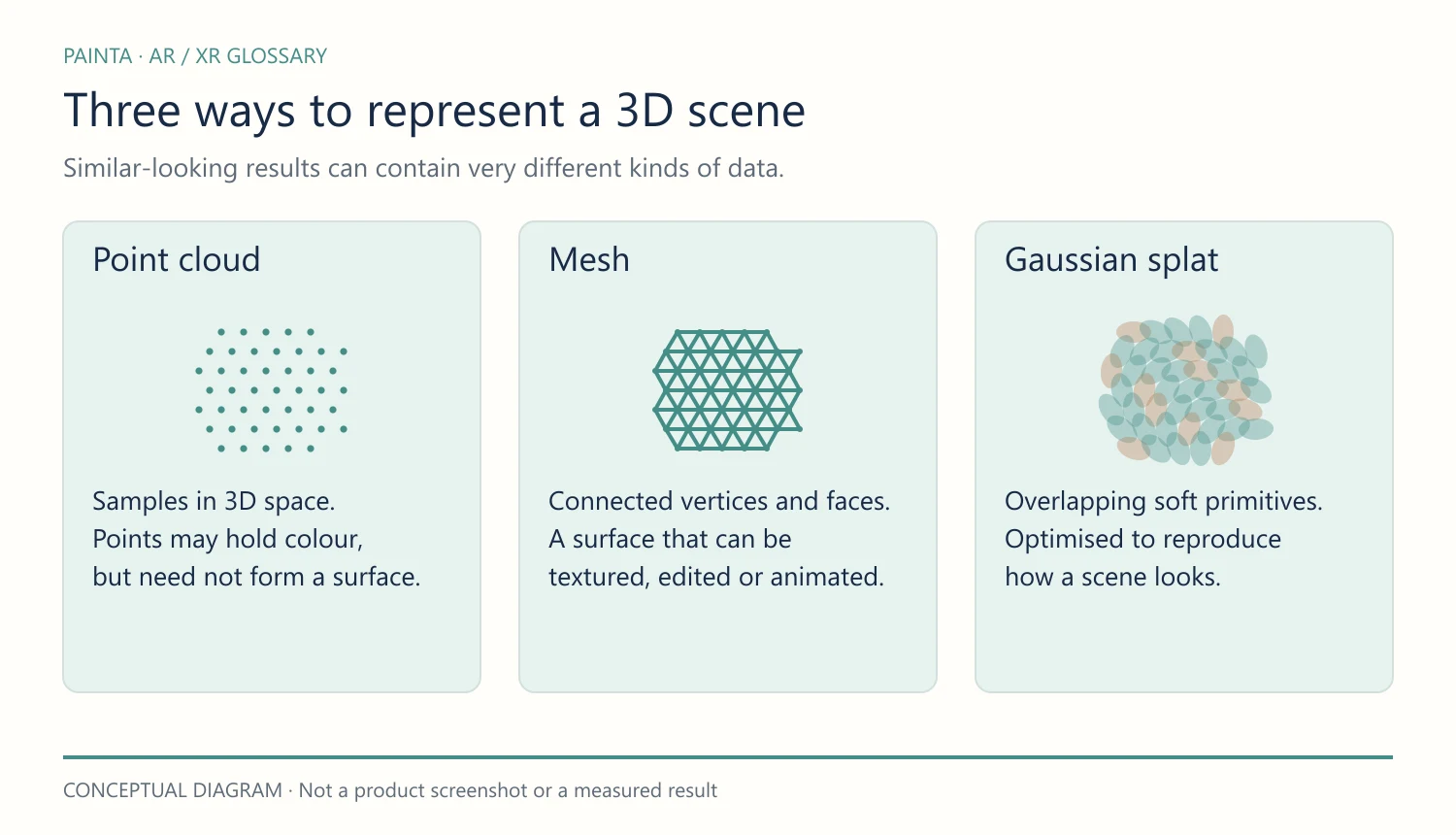
A mesh represents a 3D surface using connected vertices, edges and faces. In real-time graphics, those faces are commonly triangles.
Shape and appearance are separate
The mesh describes the surface geometry. Materials and textures describe how that surface looks when rendered. A detailed texture can make a simple mesh look rich, while a complex mesh may still look plain without appropriate materials.
It is not only a room scan
A mesh might describe a sculpture, a character, a flower or part of a building. It can be modelled by hand, reconstructed from a capture or generated by another process. The word says how the geometry is organised, not where it came from.
Why it matters in a Painta experience
A 3D asset prepared for an artwork needs to load and render comfortably on the visitor's device. Mesh complexity is one part of that budget; texture sizes, materials and animation also matter. A smaller triangle count alone does not guarantee a fast or attractive result.
Compared with points and splats
A point cloud stores samples without necessarily connecting them into a surface. A splat representation uses overlapping primitives to reproduce appearance. Converting either into an editable mesh can involve trade-offs and extra processing.
Related concepts and further reading
Splats, photogrammetry and 3D models