Polygon count is the number of faces in a mesh; for real-time delivery, the exported triangle count is often the more useful comparison.
Not every face is the same workload
A modelling application may display quads or polygons with many sides. A real-time renderer commonly works with triangles, so an export can report more triangles than the source reports faces. A cube with six quad faces typically becomes twelve triangles. Comparing counts is meaningful only when both measurements describe the same thing.
More geometry is not automatically more detail
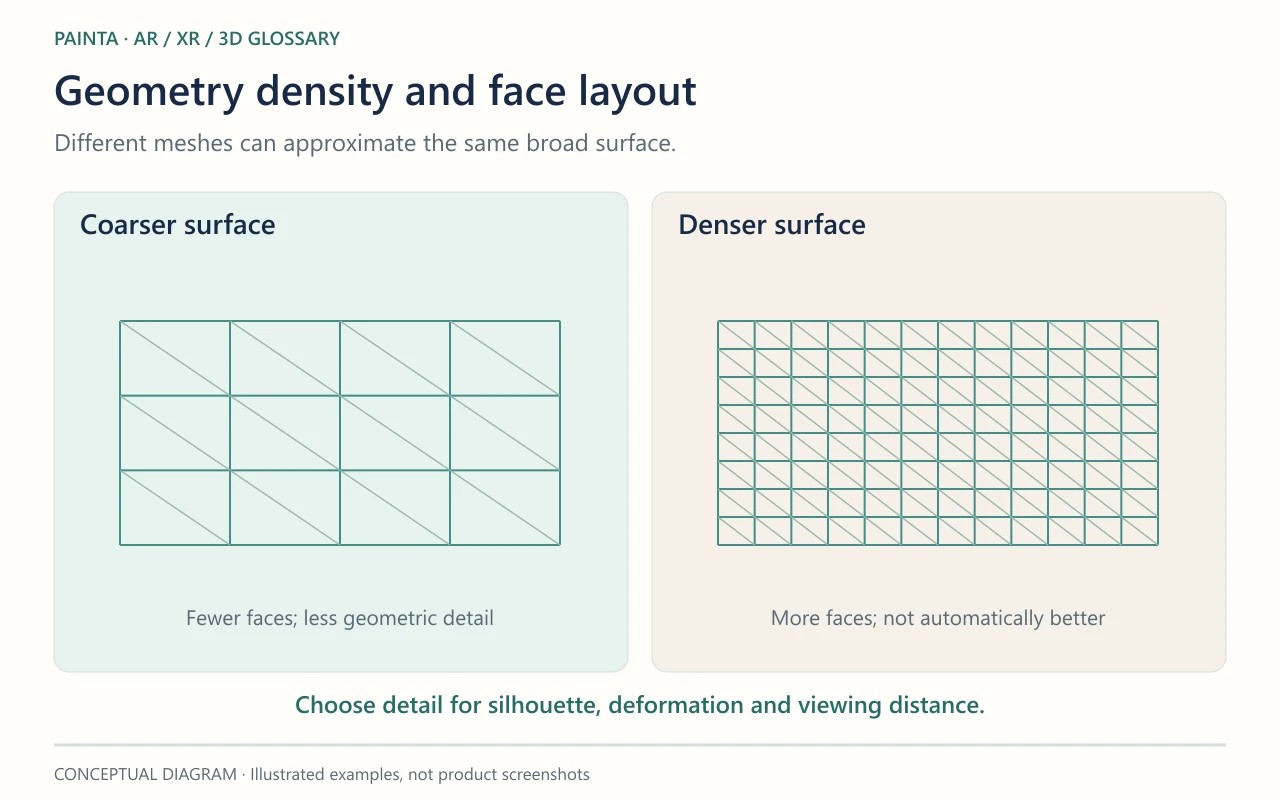
A dense mesh can still have a blurry texture, and a lighter mesh can look convincing with a strong silhouette and suitable shading. Cost also depends on materials, transparency, skinning and how many objects are visible. There is no single polygon limit that guarantees smooth AR on every phone. Measure the complete scene on representative devices.
Where to spend the detail
For a sculpture in Painta, preserve the outline and features a visitor will approach closely. Flat hidden areas rarely need the same density as a face or a curved edge. Compare the original and reduced model from the expected viewing angles before approving it. The diagram shows different surface densities; the goal is useful detail rather than a high number for its own sake.
Related concepts and further reading
Khronos: glTF 2.0 specification