Gaussian splatting represents a scene with many overlapping, soft 3D primitives, optimised to reproduce its appearance from different viewpoints.
Why can it look so convincing?
A capture is usually built from photographs or video frames taken around a scene. During reconstruction, the system adjusts the position, shape, opacity and appearance of the primitives. When they are projected onto the screen, their contributions blend into a view of the scene. Fine textures and complex visual detail can look remarkably lifelike.
See the concept in motion
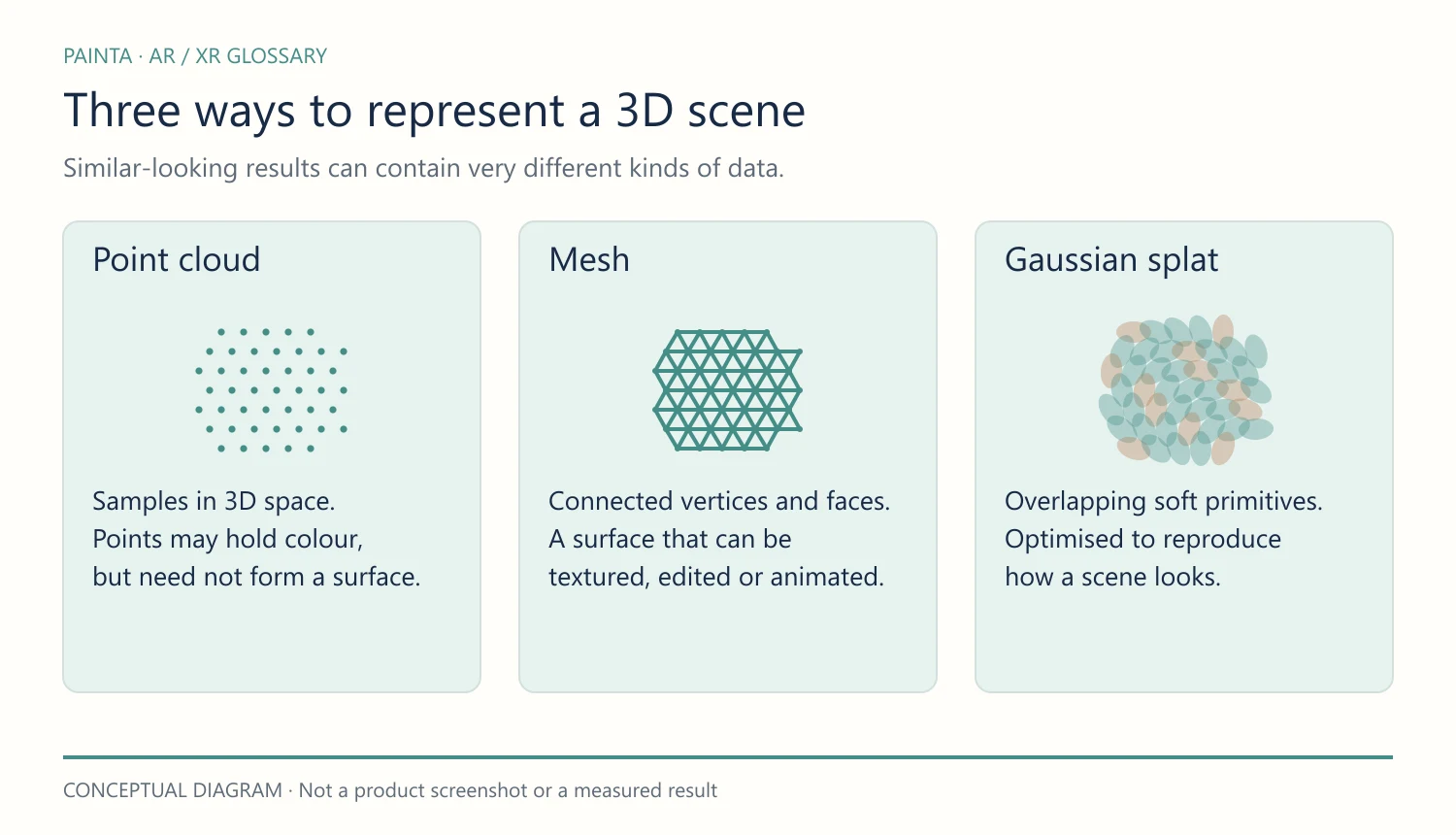
A splat is not a ready-to-animate mesh
A conventional mesh has connected surfaces. A splat representation does not automatically provide clean topology, a skeleton, watertight geometry or reliable measurements. Making it suitable for an animated character, fabrication or a specific AR viewer may require a different capture or conversion workflow.
Where it helps an art project
A gallery might use a splat to let people revisit the atmosphere and arrangement of an installation. That is a different goal from giving a conservator an accurate, measurable model of an object. Areas that were not photographed well may contain gaps or unstable detail.
Before choosing a delivery platform
Test the actual file, browser and device. A service that accepts GLB models does not necessarily accept splat formats. For a Painta project, confirm the supported delivery route first; this definition does not imply native splat import. A video of a capture can show its appearance, but it cannot offer the same freedom of viewpoint.