A neural radiance field, or NeRF, is a learned representation of a scene that can render new views by predicting colour and density along camera rays.
A way to learn how a scene looks
In the original NeRF approach, a neural network learns from images with known camera poses. It predicts how locations in space contribute to a view, taking the viewing direction into account. Rendering combines those predictions to create an image from a chosen viewpoint.
How it differs from a mesh or a splat
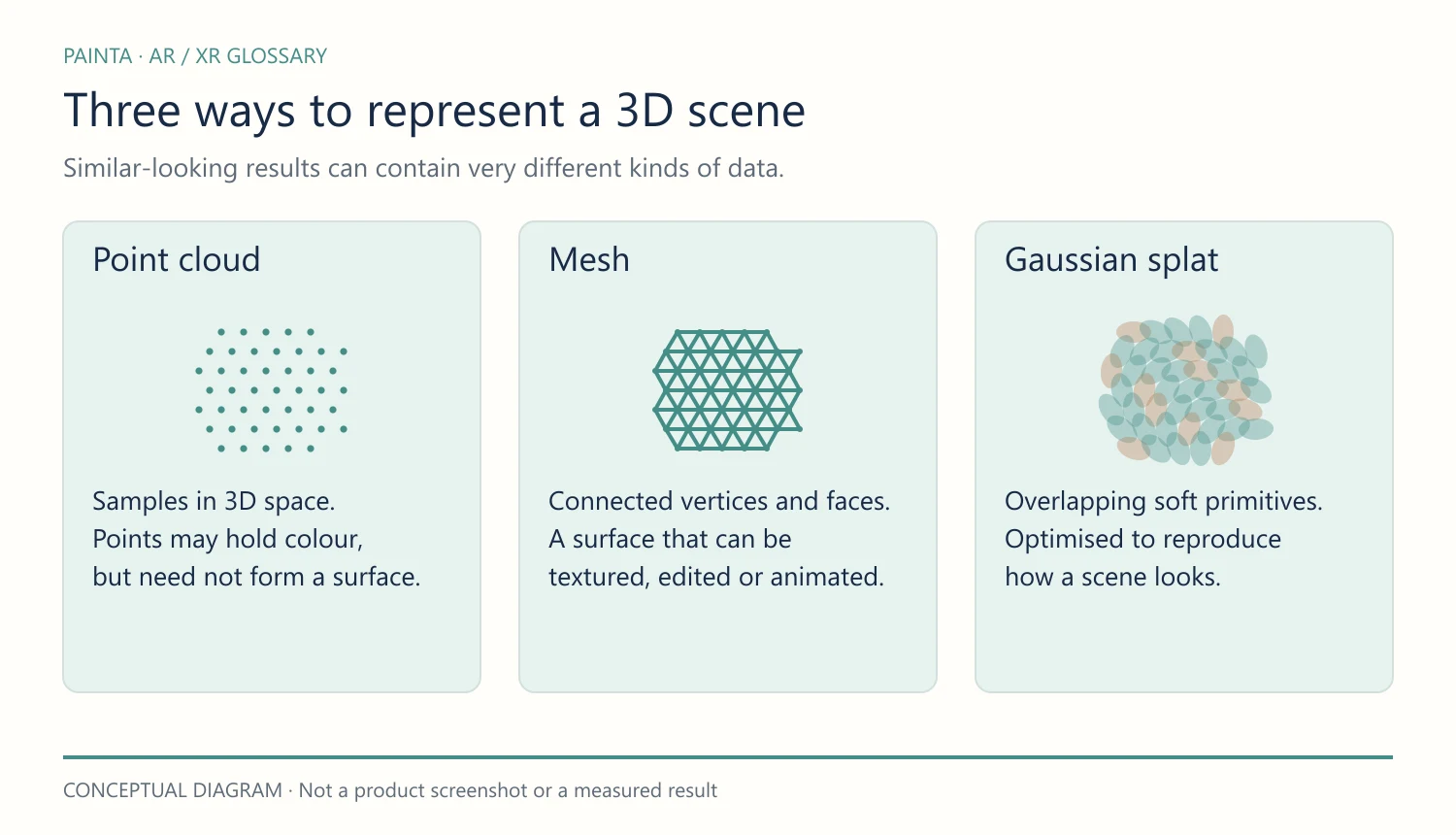
A mesh stores connected surfaces. A NeRF represents a scene through a learned function. Gaussian splatting uses explicit primitives. All three can produce convincing images, but their editing tools, export options and performance characteristics differ.
An exhibition example
A captured installation may let a remote visitor look around its arrangement. That visual experience is not proof that every hidden surface or physical dimension has been recorded correctly. Unseen areas and views far outside the capture path deserve particular scrutiny.
What to ask before commissioning a capture
Ask for the editable source, the supported viewer, the export formats and a sample on an ordinary phone. A rendered video is useful documentation, but it is not an interactive NeRF. Do not assume that a platform's support for standard 3D models also means native NeRF support.