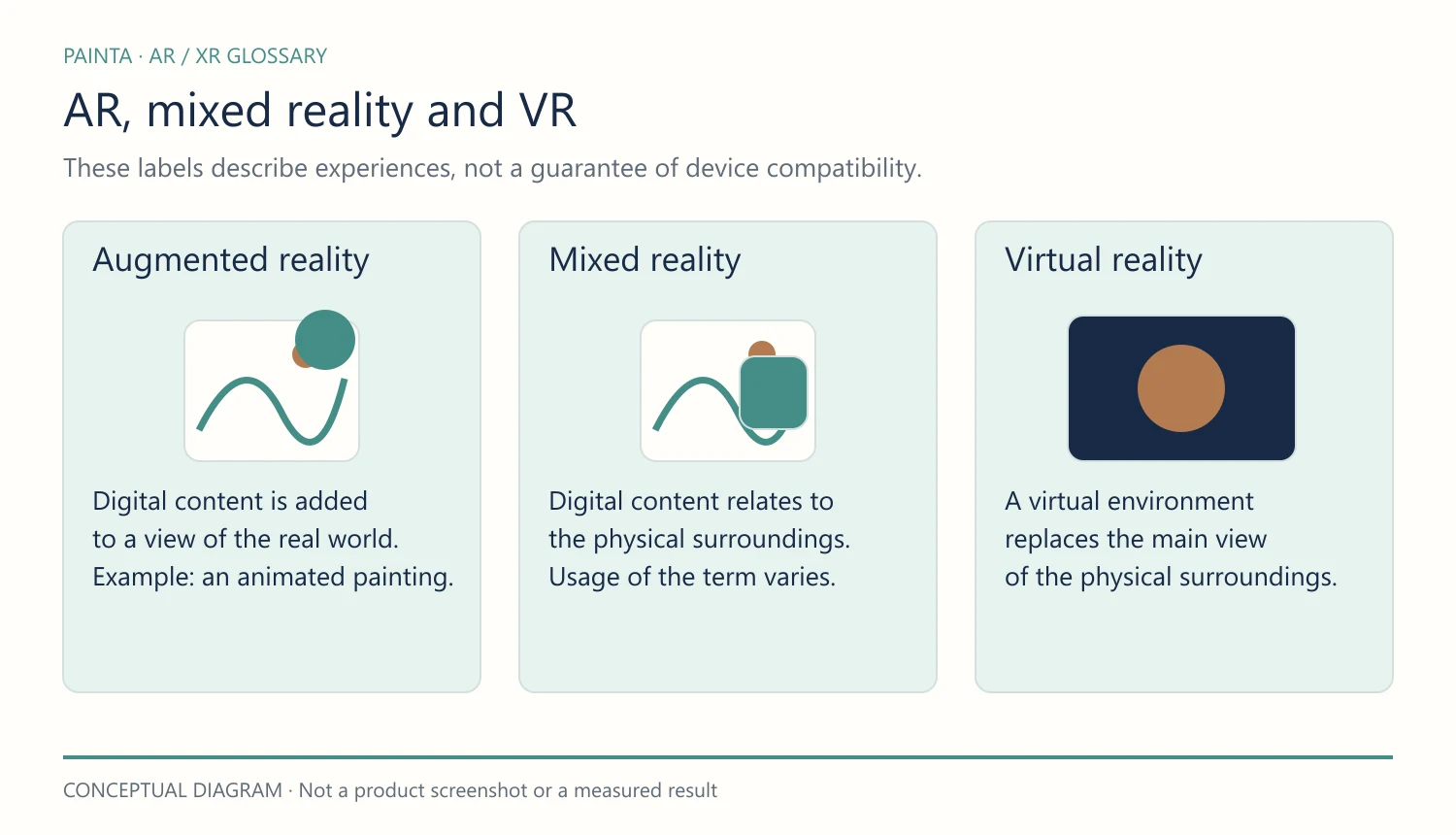
Virtual reality, or VR, presents a computer-generated environment that replaces the user's main view of the physical surroundings, typically through a headset.
What changes for the visitor?
Instead of viewing digital content over a painting in the room, the visitor enters a virtual space. They might explore a reconstructed studio, walk through an imagined landscape or encounter an artwork at an impossible scale.
VR is different from a 360-degree image
A panoramic image lets someone look in different directions from a capture position. A room-scale VR experience may also let them change position and interact. Not every VR experience offers the same freedom of movement, and a 360-degree video is not automatically a complete 3D reconstruction.
Planning a museum experience
Consider headset fit, visitor supervision, seated access, hygiene, comfort and an alternative for people who cannot or do not want to wear the equipment. Those practical choices are part of the exhibition design.
How it compares with Painta's artwork AR
An image-tracked Painta experience keeps the physical work in view through the camera and adds a digital layer. That is AR. A browser delivery method does not by itself turn the experience into VR or guarantee headset compatibility.