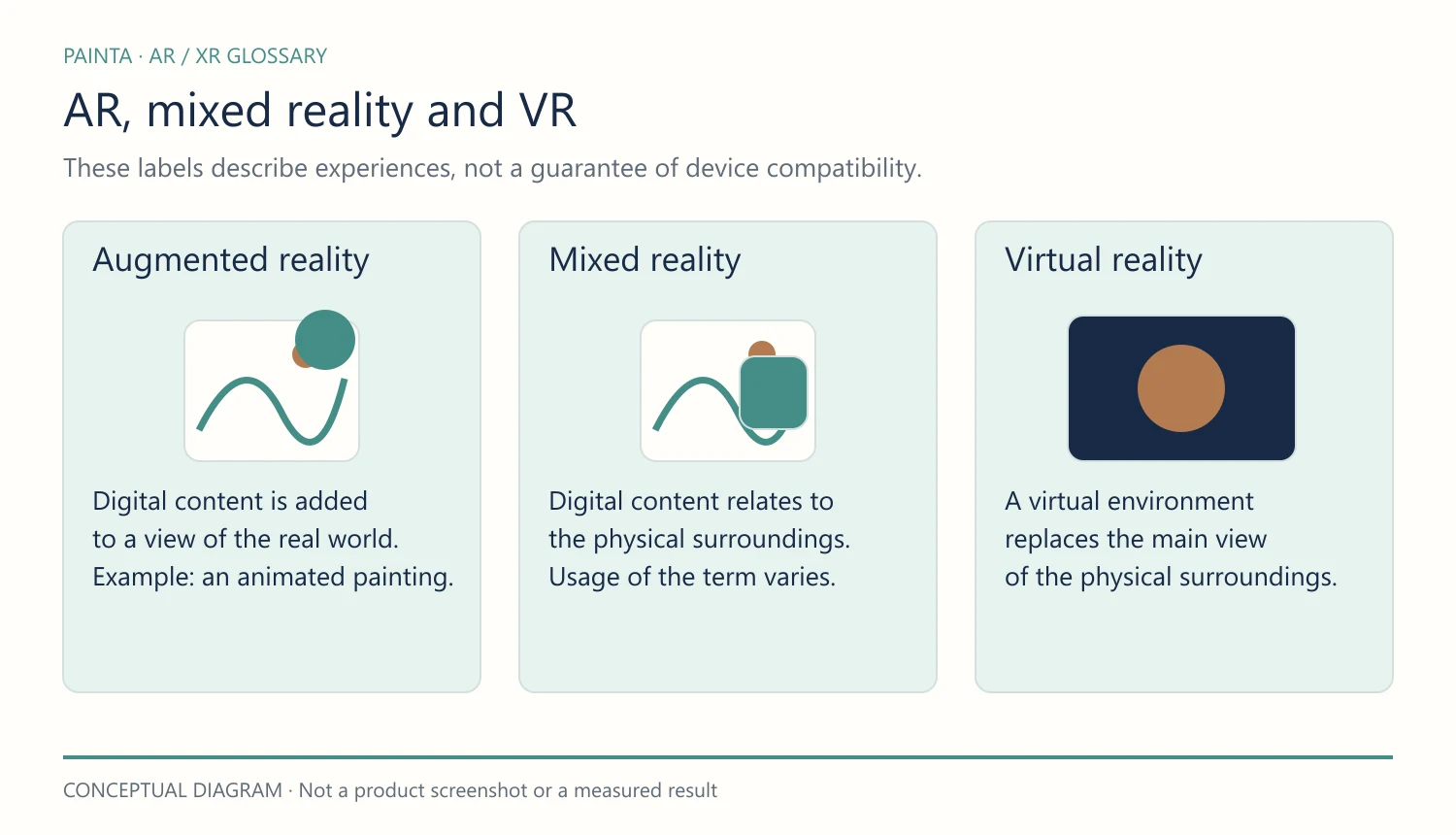
Mixed reality describes experiences in which digital content and the physical environment are presented together, often with spatial relationships or interactions between them.
Why the label can be confusing
Some organisations use mixed reality broadly for the continuum between physical and virtual experiences. Others use it more narrowly for content that responds to a room, its surfaces or the user's hands. Ask what the experience actually does rather than relying on the label alone.
An example in an exhibition
A virtual sculpture might sit on a real plinth while a visitor walks around it. If the system understands the surroundings, part of the sculpture may be hidden behind a real object. Placement, occlusion and interaction are separate capabilities; an experience may support one without all the others.
What this means for curators
Check the exact headset, browser, controls and installation setup. A display that shows a camera feed of the room does not automatically recognise every object in that room. The terms AR, MR and XR are useful starting points, not compatibility certificates.
Where Painta fits
For an artwork viewed through a phone, describe the actual AR interaction clearly. Visitors benefit more from knowing what to point at and what they will see than from being asked to interpret an unfamiliar hardware category.