WebGL is a browser graphics API that lets web applications draw hardware-accelerated 2D and 3D graphics in a canvas without installing a browser plugin.
The graphics layer behind a browser scene
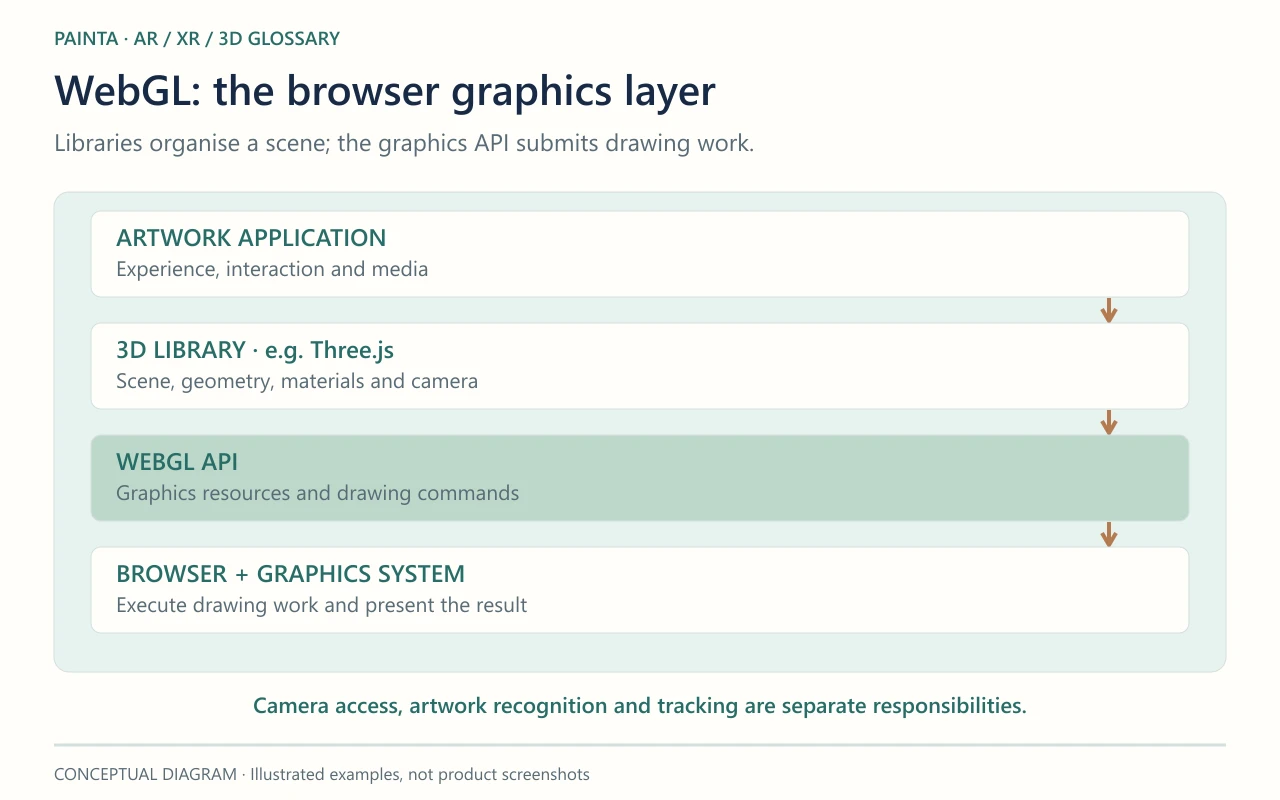
When a web page displays a rotating 3D artwork, it needs a way to send drawing work to the graphics system. WebGL provides that low-level interface. It handles graphics resources and drawing commands rather than understanding an exhibition, a character or a painting. Developers often use a library such as Three.js to organise scenes and make those drawing operations easier to manage. The diagram shows these responsibilities at different levels.
WebGL, WebAR and WebXR are different names for different jobs
WebAR describes augmented reality delivered through the browser. WebGL can provide its graphics, but it does not by itself recognise a painting, open the camera or estimate a target pose. Image tracking handles a different part of the experience. WebXR exposes supported immersive device capabilities to a web application. These technologies can work together; knowing one is present does not establish that all the others are available.
Compatibility includes the device and the scene
WebGL has more than one API version, and applications can depend on particular features or extensions. Browser support alone does not guarantee that every model, shader or scene will work well on every device. Available graphics resources and application design matter too. A GLB file stores an asset; it is not a WebGL program and does not guarantee support for every effect used by its author.
What an artist or curator can do with this knowledge
When preparing a Painta artwork, you usually make decisions about media, composition and model preparation rather than writing graphics commands. If the scene struggles, ask whether the issue is loading, tracking or drawing. Check the same published work in the intended browser, reduce unnecessary rendering cost where measurements justify it, and preserve the visual elements that carry meaning. This vocabulary makes a technical conversation more precise without requiring the exhibition team to become graphics programmers.