Collecting AR art: what it means to live with the work
person
Painta.me
Sep 30, 20266 min read
Imagine finding a print you would happily live with. Its colour works in your room, its image holds your attention, and then the artist shows you another part of it: a movement, a voice or a scene that appears when you look through your phone.
The surprise can be delightful. The next question is quieter: what will it be like to live with this work after that first demonstration?
Collecting a work with augmented reality involves the ordinary pleasure of looking at art and a few additional conversations. You do not need to become a software expert. You do need a clear understanding of what the artist considers the work to be, how you encounter it and what support surrounds its digital element.
Photo: Painta.me · Original AI-generated editorial illustration
Give the physical work its own time
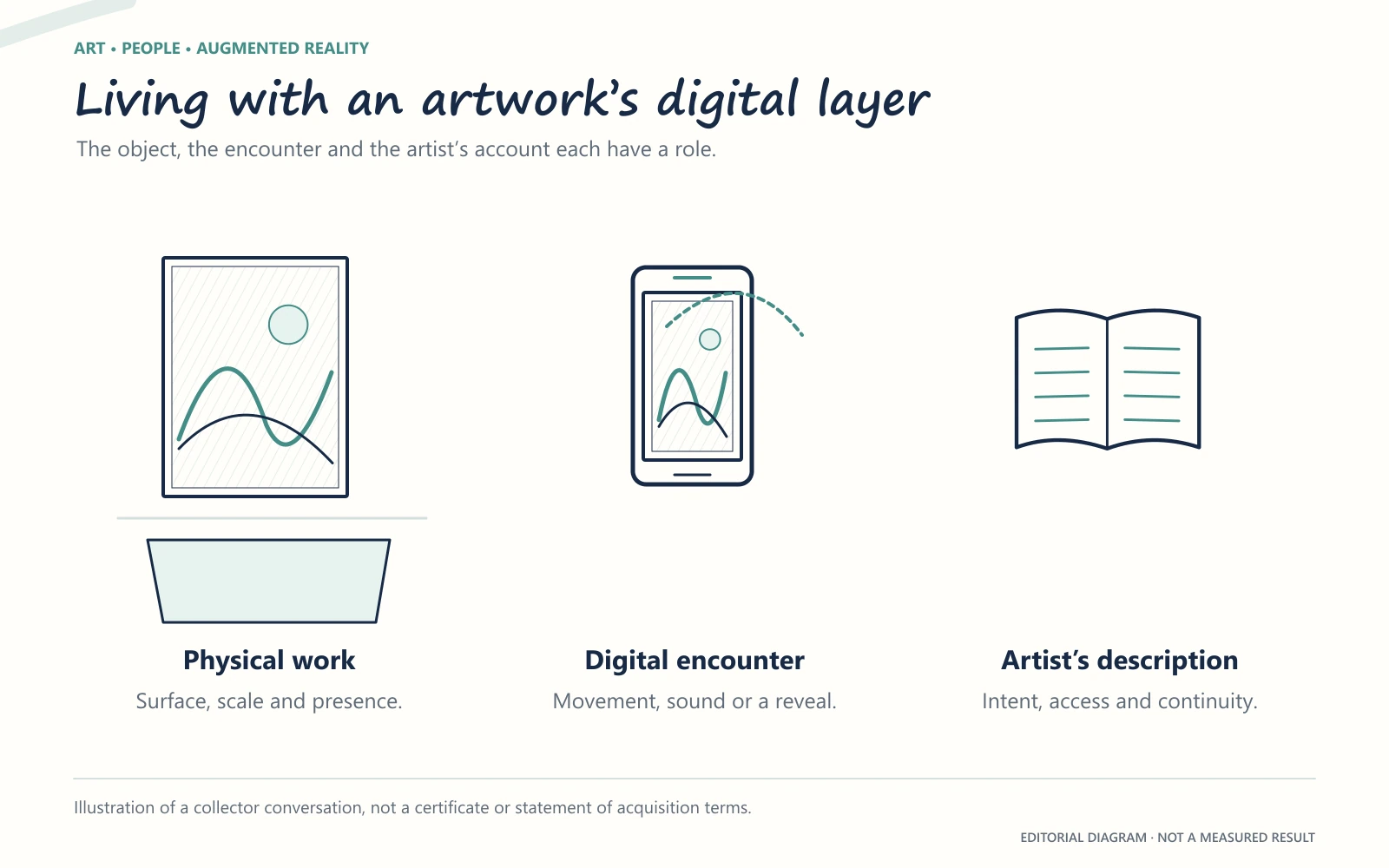
Before the demonstration, look at the object. Notice its surface, size and relationship to the room. Afterwards, put the phone down and look again. Has the digital experience changed what you see? Does the still image now hold a trace of the motion or voice you encountered?
There is no rule that the physical element must feel complete on its own. An artist may deliberately make a work whose meaning depends on moving between different states. What matters is understanding that choice, rather than discovering later that you expected a conventional print with an optional bonus.
The relationship can be playful, unsettling or contemplative. Try to describe it without listing the technology. “The landscape gradually remembers another season” says more about why you might want to live with a piece than “it includes an animated overlay.”
Ask what belongs to this particular work
“AR artwork” can describe a physical piece with a digital layer, a sculpture placed virtually in a room or a larger experience with several connected elements. A demonstration does not automatically explain what accompanies an acquisition.
Ask the artist or gallery to describe the physical object, the digital experience and the information supplied with them. Is the online layer publicly viewable? Is it shared across an edition? Is this a fixed version or something the artist intends to revise? A shared digital experience can be an intentional and interesting part of the work; the collector simply needs to know.
Public access and a meaningful art experience already coexist. At KAWS: NEW FICTION at Serpentine in 2022, the institution described physical and AR works, including versions that audiences could view at home through Acute Art. That exhibition is an example of distribution, not evidence about the terms of any particular acquisition.
A clear conversation helps a collector understand the physical work, the intended digital experience and the practical arrangements around it.
Try the encounter in ordinary conditions
A gallery demonstration is useful, but it is only one setting. Ask to try the work on your own phone, with the instructions you would receive. Notice whether you can start it independently and whether you understand when the experience has finished.
Think about the place where it will live. Is there enough distance to view the image comfortably? Will a frame or reflective surface complicate the encounter? Would the audio feel welcome in that room, and can the work still be understood when you prefer silence? These are questions of daily enjoyment as much as technology.
If the idea depends on a headset, establish exactly which equipment is involved. “XR compatible” is too broad to settle the matter. Our article on glasses for AR art explains why screen glasses, spatial AR glasses and mixed-reality headsets should not be treated as interchangeable.
It is reasonable to ask for a slower second viewing. A short loop may reveal an interesting structure on repetition; an effect that felt impressive once may offer less to return to. Your attention over time matters more than your reaction in the first few seconds.
Let the artist explain the rhythm
Some works are meant to be discovered occasionally. Others invite a regular return. Sound may be essential, or the artist may regard it as one possible accompaniment. A changing sequence may be central to the work, while a decorative transition may be replaceable.
Ask what the artist wants you to notice, and what they regard as essential. That conversation can be as revealing as a studio visit. It gives the digital element an artistic vocabulary rather than leaving it described only by file types and devices.
The Variable Media Questionnaire offers a historical precedent for documenting creators' views about how works should be experienced and, where appropriate, translated as media change. A private collector need not reproduce an institutional process. The underlying question is accessible: which qualities make this work itself?
Keep that answer with the work. An artist's explanation of pace, scale or the relationship to a physical image can remain valuable when a promotional video no longer captures the whole experience.
Make the everyday arrangements legible
The gallery should be able to explain how to access the experience, who to contact if something stops working and what duration of access or support is actually being offered. If there are recurring responsibilities or costs, make them explicit. An appealing phrase such as “always available” deserves a concrete explanation.
Ask what information will remain with you: a description, access instructions, reference images or a recording approved by the artist. These materials do different jobs. A video may help you remember a work's behaviour, but it does not necessarily preserve the interactive experience itself.
The Guggenheim's work on technology-based art treats the care of computer-based works as an ongoing field of research. That is a useful reason to welcome thoughtful documentation, not a reason to assume every digital artwork requires a museum conservation department in your living room.
For a fuller discussion of continuity, read our article on caring for AR artworks. At the point of choosing a work, the immediate aim is simpler: leave with a shared understanding rather than a collection of assumptions.
Galleries can make this conversation feel natural
An artist or gallery does not need to overwhelm a prospective collector with a technical presentation. Show the work, let the person try it, explain the intended experience and supply a concise written description afterwards. Separate the artistic story from the practical arrangements so both can be understood.
For artists developing this kind of encounter, Painta offers a place to explore an artwork with a digital layer. The useful exercise is to show it to someone without narrating every action, then ask what they understood and what they would need to enjoy it again at home.
The most compelling reason to choose the piece should still be the relationship you want with it. A good explanation of its digital life gives that relationship room to grow.
Founder and creator of Painta.me. Artist in my spare time and AR art enthusiast. Building tools to help artists bring their creations to life through augmented reality.
A short weekly email with new Painta.me tools, practical AR ideas, artist opportunities, and ways to make your work easier to create, publish, and share. Useful even if you haven't created your first piece yet.
What you'll get
1
New AR tools
See what's new inside Painta.me and how it can help you create faster.
2
Artist opportunities
Open calls, featured works, community updates, and ways to get your art seen.
3
Practical AR ideas
Simple techniques to create, publish, and share better augmented reality pieces.
auto_awesome
Ready to create?
Create your free account, prepare an artwork and share it in augmented reality. Choose a paid plan when you need more.