Digital art beyond NFTs: what earns a gallery's trust
person
Painta.me
Oct 13, 20267 min read
Among the concerns I brought back from Talking Galleries was how quickly a conversation about digital art can become a conversation about NFTs. In my notes, memories of speculation sit beside questions about artistic quality, permanence and the place of screens in a gallery. Those concerns deserve to be separated carefully.
The association is understandable. A highly visible market can shape the language people use for a much wider field. But it can also make a gallery judge a proposal through expectations that have little to do with the work in front of it. An artist presenting a moving image may find themselves answering a question about a token they never intended to use.
This article develops one thread from my reflections on Talking Galleries. It is a way to make the conversation more precise, including for people who remain unconvinced by a particular digital proposal.
Photo: Painta.me | Original AI-generated editorial illustration. Conference photographs by Bernie Torras.
The work, the token and the encounter
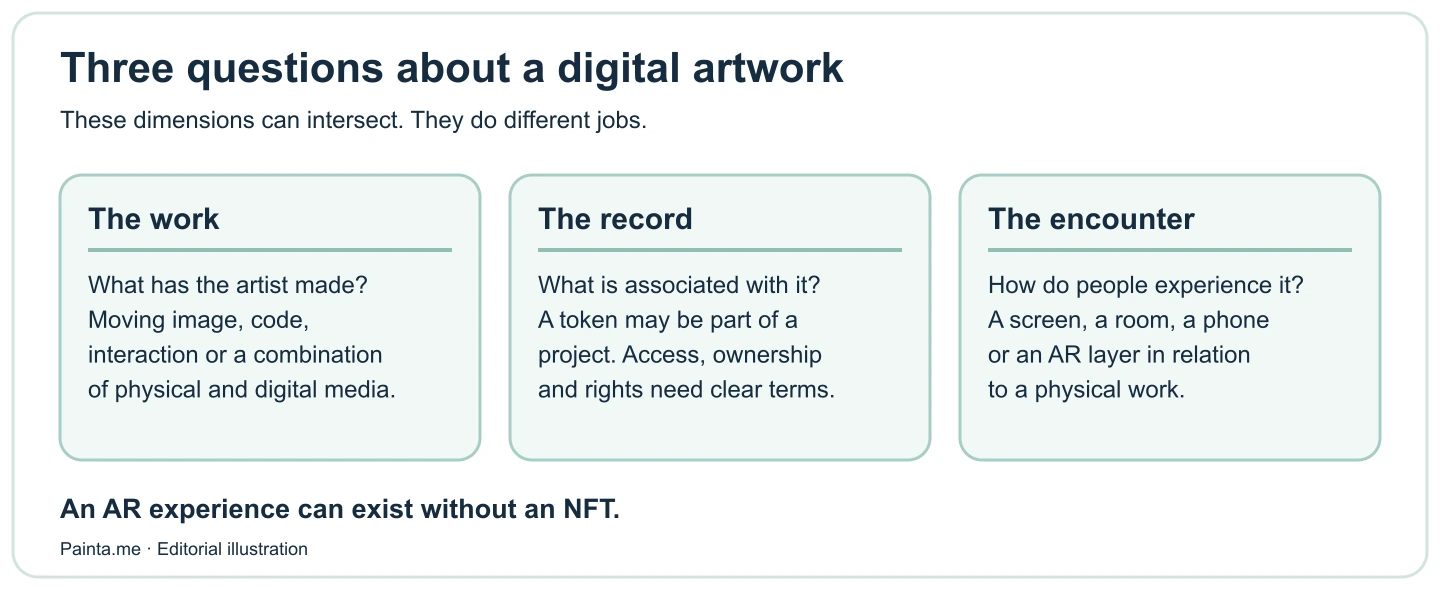
Digital art describes a broad range of artistic practices using digital tools or systems. A work might be a moving image, a programmed behaviour, an interactive environment or a combination of physical and digital elements. Those descriptions tell us something about what the artist has made.
An NFT is a distinct record on a blockchain, associated with an asset. It concerns a different layer of the project. The record, the artwork it refers to and the arrangements around that artwork need to be understood separately. The presence of a token does not explain how a work should be experienced or what rights accompany a purchase.
Augmented reality describes another dimension: digital content encountered in relation to a view of the physical world. An artist might make movement appear in relation to a printed image or position a digital form in a room. That experience can exist without an NFT. It can also be part of a project that uses one.
An original Painta explanatory diagram. Artistic medium, records associated with a work and viewing experience are different dimensions of a project; they can intersect.
These distinctions create room for better questions. What has the artist made? How will a visitor encounter it? What is actually being offered to a collector? A clear answer to one does not automatically settle the others. Our article about living with an AR artwork looks at the practical conversations a collector may need.
What the demand slide can and cannot tell us
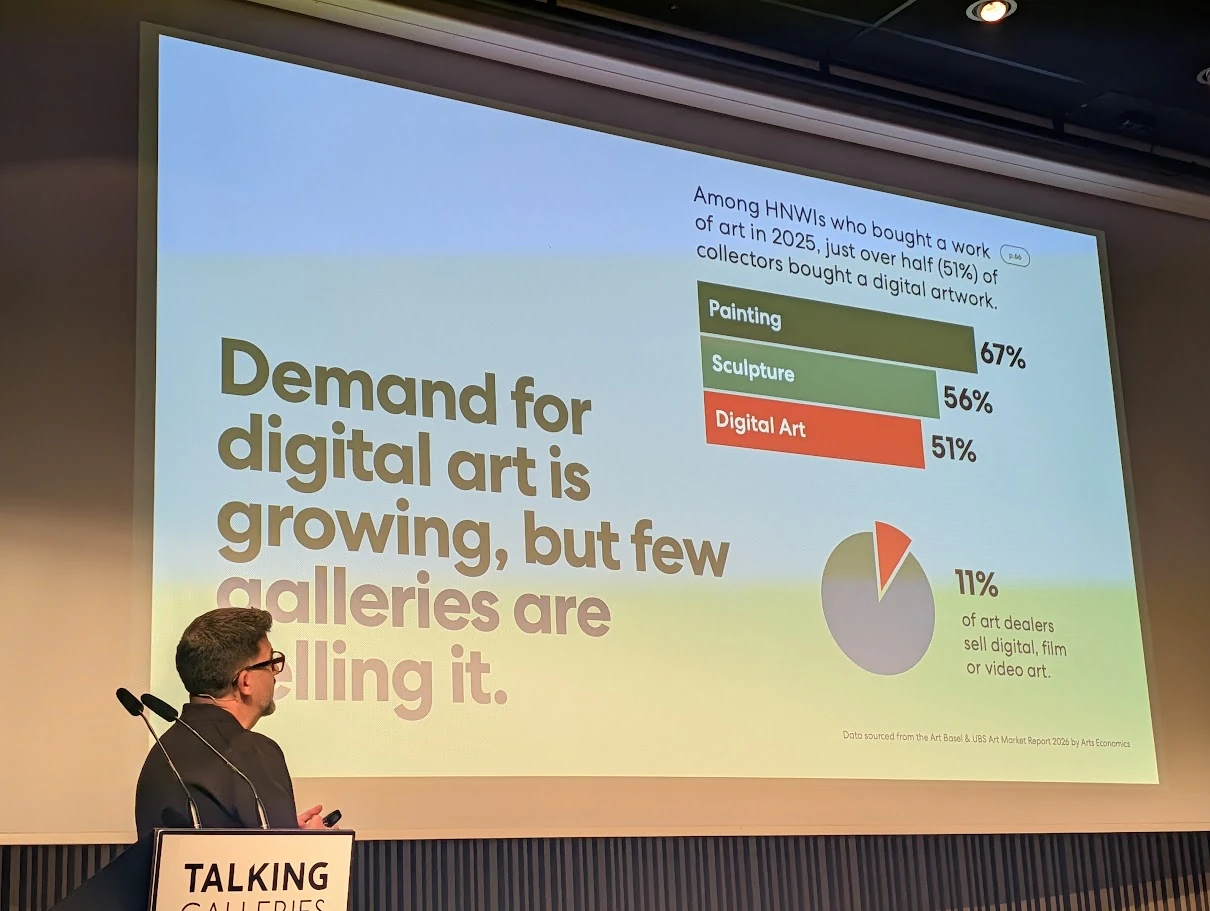
One slide I photographed at Talking Galleries placed interest among wealthy collectors beside the proportion of dealers selling digital work. It was an effective prompt to think about how demand and gallery programmes meet. The underlying definitions matter, however.
Pau Walder at Talking Galleries, 6 October 2026. Photograph by Bernie Torras. The buyer figure comes from the 2025 collecting survey, covering 2024 and the first half of 2025; the dealer figure concerns 2025. They describe different populations and categories. Sources are linked in the text.
The 2025 Art Basel and UBS collecting survey found that 51% of surveyed high-net-worth respondents who had bought fine art had purchased a digital artwork. The purchases covered 2024 and the first half of 2025. This describes a particular group of collectors, not half of all art visitors.
The 2026 art market report separately reported that 11% of surveyed dealers sold digital, film or video art in 2025. The two percentages concern different populations and different categories. Subtracting one from the other would not reveal an unmet market, and neither figure measures demand for AR specifically.
For a gallery, the useful next step is closer to home. Which artists in its programme are working in these media? Which existing visitors or collectors want to spend time with that work? What would make a presentation intelligible to someone encountering it for the first time? A large survey can open the question; the gallery still has to investigate its own relationships.
Some galleries already have experience to build on
It would be misleading to describe the sector as uniformly resistant to digital art. Victoria Miro's documented presentation at Untitled Art in 2023 connected works shown physically at the fair with a digital extension through Vortic. It is a historical example of a gallery bringing different forms of presentation together, not a claim about sales results or today's device support.
NFT projects also need to be considered individually. MoMA Postcard, which ran from 2023 to 2024, used blockchain as part of a collaborative creative project. That does not erase concerns about speculation. It does show why speculation alone is too narrow a description of every practice involving a token.
These examples change the tone of the conversation. A gallery can bring existing experience, including disappointments, to a new proposal. An artist or technology partner should want to hear what has been tried, what became difficult and what the team would do differently.
Spectacle is a choice with consequences
Another concern in my conference notes was the association between AR, immersive work and spectacle. I do not think an experience becomes artistically weak because it is surprising, entertaining or visually intense. Those qualities can belong to the work. A quiet presentation can be empty too.
The more revealing question is why this particular effect exists. Does it extend the artist's use of movement? Does it reveal a relationship that is difficult to see? Is the interruption itself part of what the artist wants to explore? Or has an impressive effect been added because the presentation needed a demonstration?
Imagine a print in which a line gradually moves out of alignment with its physical version. That small displacement could express uncertainty or a memory changing. A much larger, louder animation might be right for a different work. Judging either by how much movement appears on screen would miss the point.
A useful second viewing often reveals more than a first reaction. Does the work offer something to return to once the mechanism is familiar? Does the person looking at it develop a question beyond how it was made? Our museum AR examples offer several ways of relating an added experience to an object.
A specific proposal is easier to trust
For an artist approaching a gallery, clarity can begin with a modest description: the physical element, the digital material, what a visitor does and the intended artistic relationship. A real capture of the experience helps, particularly when it shows ordinary viewing conditions rather than only a polished promotional sequence.
The practical questions belong in the same conversation. Who approves the content? What equipment does it need? Who maintains access? What happens if an experience becomes unavailable? These questions can protect a work's intention rather than diminish it. They are worth considering before the opening, alongside the questions in a brief for commissioning AR.
This is where Painta can play a limited, concrete role. An artist-approved digital layer can be connected with a physical artwork and explored through a phone's browser. For a gallery, the reason to consider it should be visible in the example: a voice that changes how a detail is understood, a movement that belongs to the composition, or a relationship between works that becomes easier to follow.
A small pilot with a clear purpose gives the team a chance to judge that contribution in its own space. Trust can grow from a proposal that is understandable, a responsibility that has an owner and an artwork that remains interesting after the first reveal.
Founder and creator of Painta.me. Artist in my spare time and AR art enthusiast. Building tools to help artists bring their creations to life through augmented reality.
A short weekly email with new Painta.me tools, practical AR ideas, artist opportunities, and ways to make your work easier to create, publish, and share. Useful even if you haven't created your first piece yet.
What you'll get
1
New AR tools
See what's new inside Painta.me and how it can help you create faster.
2
Artist opportunities
Open calls, featured works, community updates, and ways to get your art seen.
3
Practical AR ideas
Simple techniques to create, publish, and share better augmented reality pieces.
auto_awesome
Ready to create?
Create your free account, prepare an artwork and share it in augmented reality. Choose a paid plan when you need more.