Commissioning AR for a museum starts with a better brief
person
Painta.me
Oct 3, 20266 min read
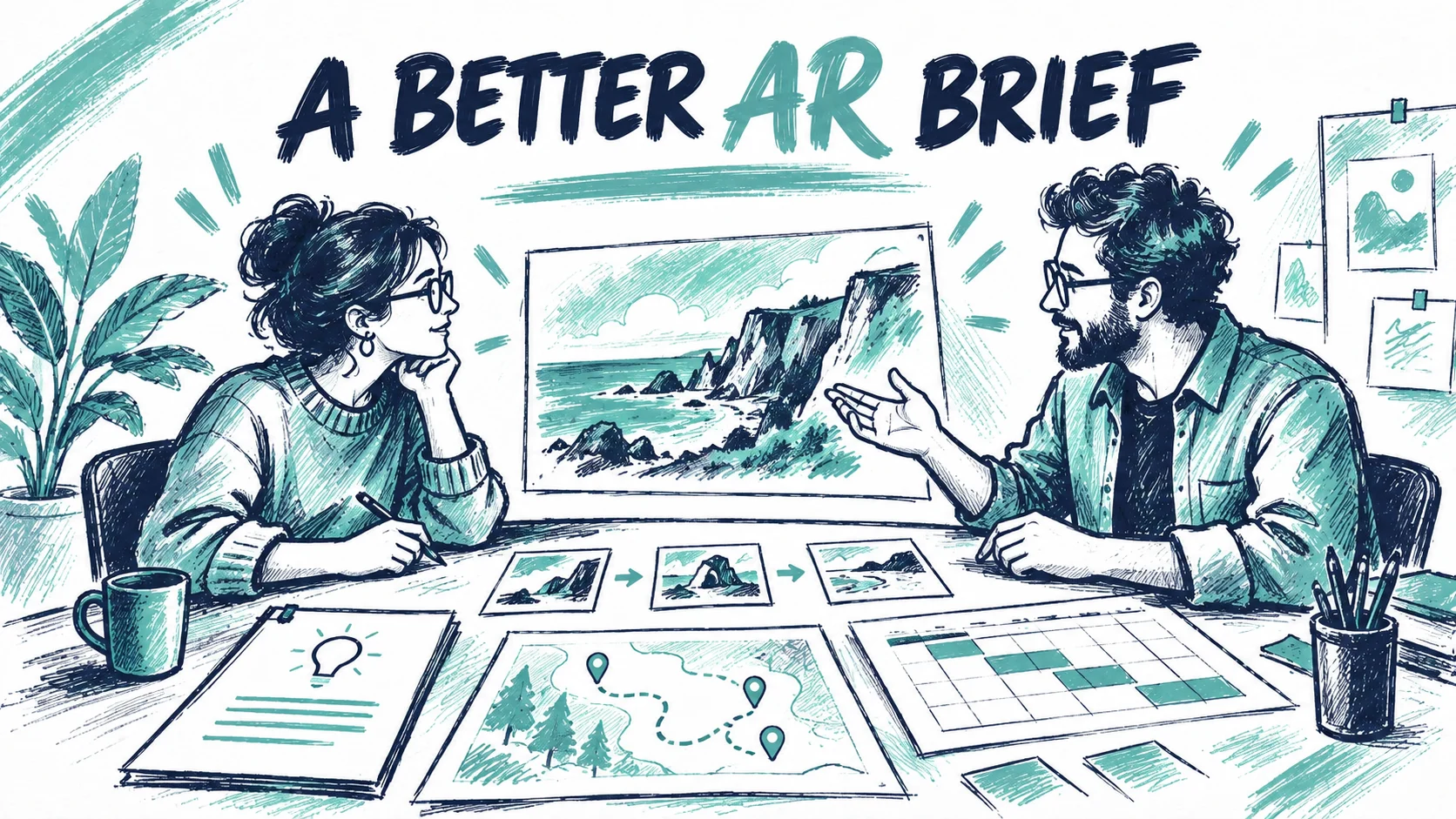
An AR commission can begin with a spectacular reference video and a surprisingly vague ambition: make the collection more engaging. The proposal arrives full of possibilities, yet nobody can quite explain what a visitor should understand afterwards.
A better brief begins closer to the object. There is something here that people struggle to see: a removed layer, the scale of a missing structure, a movement that a static display cannot show. The museum wants to make that idea accessible while keeping the physical work at the centre of the visit.
Once that purpose is clear, the commission becomes easier to discuss. Artists know what their interpretation must serve. Curators know what claims need evidence. Digital producers can assess whether the proposed experience belongs in the actual room.
Photo: Painta.me · Original AI-generated editorial illustration
Describe the question before the effect
Compare two hypothetical briefs. One requests a dramatic animation for a ceramic vessel. The other asks visitors to understand how separate fragments relate to the vessel's possible original form, while making uncertainty visible. Both might lead to animation, but the second provides a basis for judging it.
Write the interpretive question in language a colleague outside the project can understand. Name the object, the intended audience and what remains difficult to communicate through the current display. Include why AR might help: perhaps the relationship between fragment and outline matters spatially, or the visitor needs to compare two states while looking at the original.
Smithsonian Exhibits has described the value of developing AR and VR alongside an exhibition's interpretive planning, design and content. The medium becomes more useful when it participates in an existing purpose. Our article on museum AR that serves the artwork explores that curatorial decision in more detail.
Choose a scope the institution can explain
A whole collection is rarely a helpful first unit of discussion. Choose a bounded group with a clear relationship: a single work, a short comparison or a small section of an exhibition. Enough material to test the idea; little enough that the team can account for every claim and every visitor action.
Be explicit about what the commission includes. Research, script development, image preparation, translation, sound, animation, on-site testing and documentation are separate forms of work, even when one team supplies several of them. A licence to publish an experience does not, by itself, produce its editorial content.
The number of activated objects is a poor proxy for value. One well-chosen comparison may communicate more than a room in which every label promises an animation. Expansion should follow a reason, such as a new interpretive question or a visitor need revealed during evaluation.
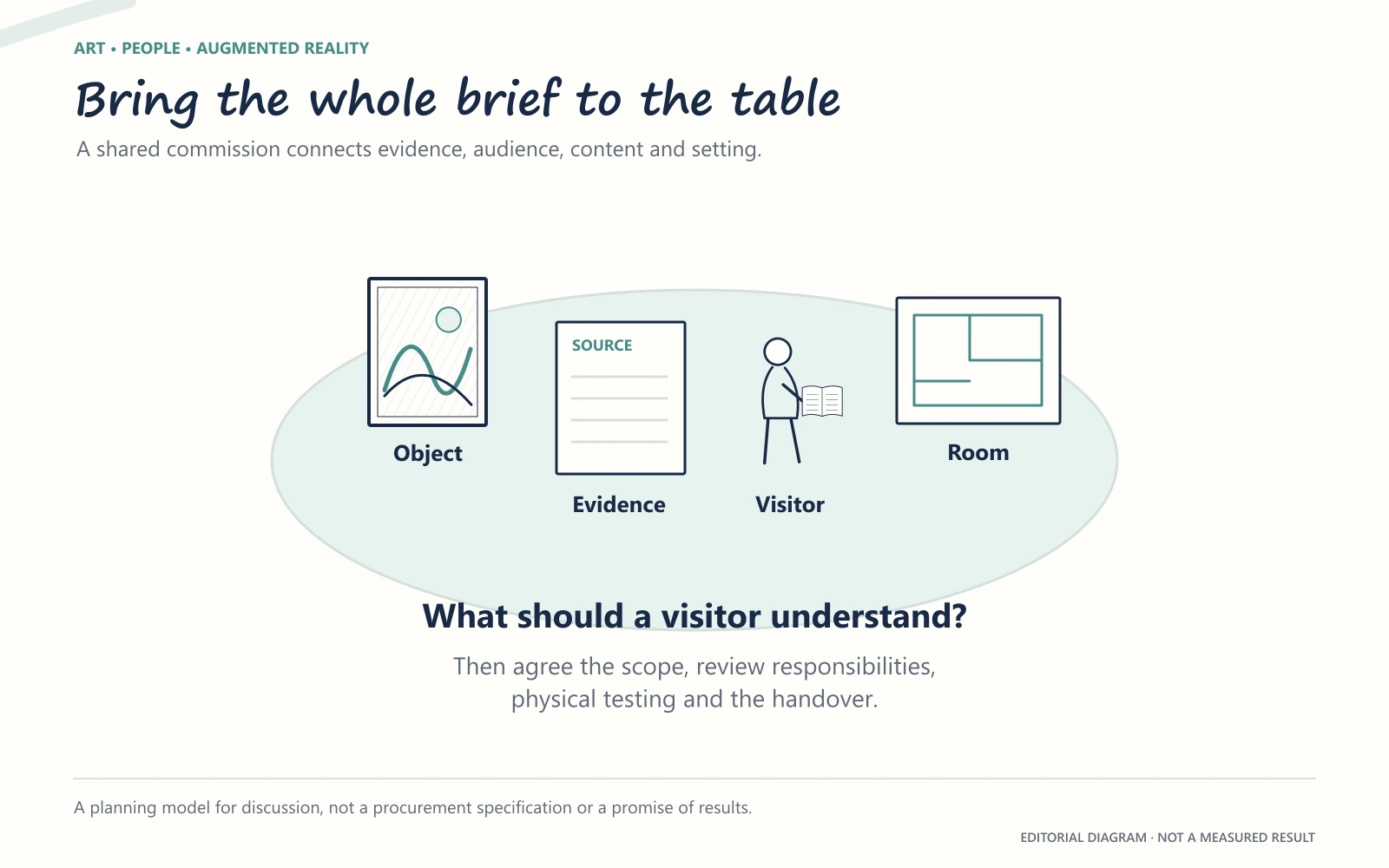
A museum AR brief becomes more useful when the artwork, evidence, visitor and real room inform the production together.
Decide who speaks, and on what evidence
An animation can make an uncertain reconstruction feel settled. The brief should distinguish documented material, informed hypothesis and contemporary artistic response. Each can be valuable, provided the visitor can understand what they are seeing.
Identify who supplies and checks source material, who approves the script and who resolves disagreements about an image or a phrase. If a community's history or living practice is being interpreted, establish how relevant voices will shape the work, rather than leaving that conversation until a polished sequence is ready.
The Louvre's 2026 Les illustres inconnus project offers a concrete reference: the museum describes six experiences developed with Snapchat's AR Studio in collaboration with curators, using archives and scientific research. It illustrates the place of research in production; it does not establish that the same scope, resources or results will suit another institution.
A convincing video does not show everything that matters in a gallery. Visitors stand at different heights and distances. They arrive in groups. Reflections move across glass. Sound travels beyond the person holding the phone.
Give prospective collaborators access to these conditions before they commit to a particular experience. Include lighting, likely crowding, available connectivity and the route visitors take through the space. If the project depends on a device supplied by the museum, include the effort of handing it out, explaining it and keeping it ready for the next person.
Access requirements belong here too. Describe how someone can understand the relevant story if they cannot hold a phone steadily, hear the soundtrack or use the camera experience. Our discussion of accessible AR exhibitions can inform that part of the conversation. It should influence the concept while changes are still straightforward.
Review proposals through the same visitor scenario
Ask each proposed team to explain how the same visitor would encounter the same object. That makes differences easier to assess than comparing unrelated showreels. Look for an understanding of the interpretive question, a plausible approach to the room and a clear account of how the work will be reviewed.
A small prototype can expose assumptions before they become expensive commitments. Agree what it must demonstrate and who will assess it. A visually rough test may be enough to settle an interaction; a content review may require a careful storyboard before polished media exists.
Define the evidence for acceptance too. “Works successfully” could mean several things. Starting without staff help, maintaining the intended alignment and communicating the agreed distinction are more specific. Our article on measuring AR exhibition success explains why scans alone cannot settle those questions.
Commission the handover as well
The person who approves the opening experience may not be the person supporting it six months later. Name who holds the source material, who can revise the project, who notices failures and who pays for continued publication. Describe what should happen after the exhibition closes.
In a MuseumPros discussion about commissioning digital exhibitions, contributors describe different arrangements for in-house work, external studios and operational handover. Their experiences are anecdotal, not a universal procurement model. The useful reminder is that the maintenance conversation belongs in the commission, wherever production happens.
A museum considering this approach can explore Painta's exhibition preparation options around a bounded first project. Bring one interpretive question and a small selection of source material to that conversation, with room for curatorial review and testing before committing to a larger collection. The exhibition setup package covers up to five artworks with finished media supplied by you, individual QR codes and digital wall labels. Animation creation, printing and on-site installation are separate. The preparation fee is also separate from the Painta plan, hosting and any Legacy Mode licence; a collection with one shared QR requires Studio Pro.
A well-shaped brief gives those people a shared question to answer. The technology then has a clear job in the room, and the museum has a reason to keep it there.
Founder and creator of Painta.me. Artist in my spare time and AR art enthusiast. Building tools to help artists bring their creations to life through augmented reality.
A short weekly email with new Painta.me tools, practical AR ideas, artist opportunities, and ways to make your work easier to create, publish, and share. Useful even if you haven't created your first piece yet.
What you'll get
1
New AR tools
See what's new inside Painta.me and how it can help you create faster.
2
Artist opportunities
Open calls, featured works, community updates, and ways to get your art seen.
3
Practical AR ideas
Simple techniques to create, publish, and share better augmented reality pieces.
auto_awesome
Ready to create?
Create your free account, prepare an artwork and share it in augmented reality. Choose a paid plan when you need more.