Why selling more art can still leave a gallery under pressure
person
Painta.me
Oct 20, 20267 min read
A sale can end with a handshake and begin a surprising amount of work. There is a frame to check, a condition to record, packaging to arrange, a delivery address to confirm and someone who wants to know when the work will arrive. The price of the piece does not tell us how much of that work it creates.
This was one of the practical tensions I brought back from Talking Galleries in Barcelona. In my notes, conversations about smaller transactions sit beside worries about shipping, storage and the cost of maintaining a space. They are observations from the event, not a description of every gallery. But they suggest a useful question: when does more activity leave a business with less room to breathe?
The question develops the operational side of my conference reflections. It also matters when a gallery considers adding any new service, sales channel or digital experience to its programme.
Photo: Painta.me | Original AI-generated editorial illustration. Conference photographs by Bernie Torras.
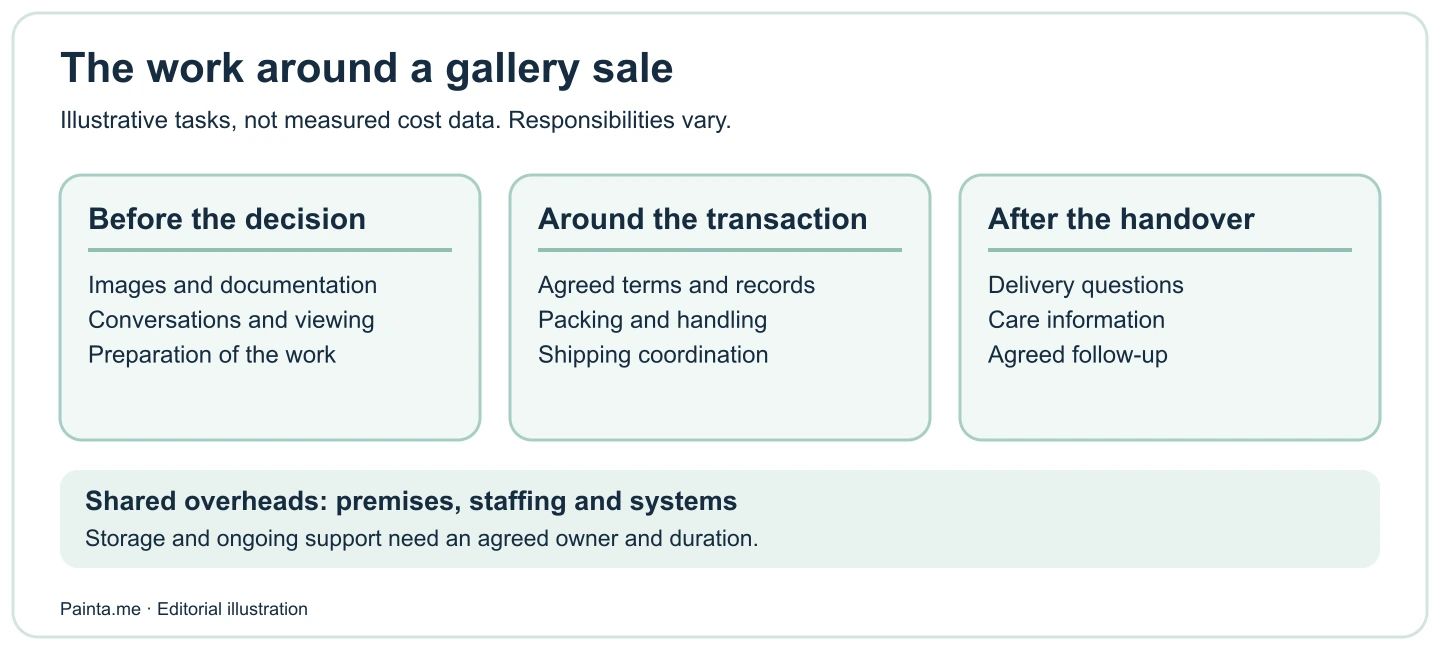
The work around a sale has its own rhythm
Imagine a gallery arranging several modest sales in the time it previously devoted to one larger transaction. This is an illustrative situation, not a case study of a particular business. Revenue could remain similar while the number of conversations, invoices, packages and delivery questions increases.
Some tasks become easier with repetition. Others remain attached to each object or person. A collector still needs a clear answer about the work. A fragile item still needs appropriate handling. A missed delivery can interrupt the afternoon regardless of the price on the invoice.
Illustrative work around a gallery sale, not measured cost data. The tasks and their allocation vary with the work, the team and the agreement.
This is why it helps to distinguish revenue from the resources a transaction leaves available. The gallery's retained share has to support the relevant costs and the wider operation. Time is part of that picture, including time that never appears as a separate line on a bill.
More accessible work can be valuable to a programme and to its audience. The decision is about how to support that activity well. Perhaps certain formats can share packaging, some information can be prepared once, or delivery expectations can be made clearer before a purchase. Those are operational choices, not judgements about the artistic worth of a smaller piece.
A market recovery is not every gallery's recovery
The Art Basel and UBS Global Art Market Report 2026 summary provides context. It reports that dealer sales rose by 2% in 2025, while total operating costs increased by an estimated 5% on average. These are different aggregate measures. They cannot be subtracted to calculate the margin of an individual gallery.
They do help explain why an improving headline can coexist with a demanding year. A business's experience depends on its artists, price range, location, buyers and costs. A change in the mix of work sold may matter as much as the total value recorded.
One of the clearest ideas in my conference notes was that there is no single art market. A small gallery building local relationships, an international dealer and an artist selling directly can encounter very different conditions. Even within one gallery, an edition and a large installation ask different things of the team.
That makes a precise question more useful than a general mood. Which activities are becoming harder to sustain here? Where is time being spent? Which commitments are essential to the programme, even when their contribution cannot be reduced to an immediate sale?
Storage turns an assumption into a responsibility
Storage was another recurring concern in my notes. Space has a cost, and so does managing what is in it. A work may need environmental care, documentation, insurance, handling or movement between locations. The arrangement becomes more difficult when everyone assumes someone else has made the necessary plan.
The suggestion that artists should take greater responsibility for their works is worth discussing, but it should not become a universal instruction. Relationships, resources and agreements differ. A gallery may have a strong reason to hold certain works. An artist may have neither the right space nor the ability to move a large piece at short notice.
The useful conversation is specific: which works, where, for how long, under whose care and with what arrangements for collection or return? Making those expectations explicit can protect the relationship. It is better than allowing a temporary convenience to become an indefinite obligation that neither side has discussed.
Digital material brings responsibilities of its own. Files, access instructions, hosting and support need attention too. Replacing one vague promise with another does not make a project easier to sustain.
Every route to a buyer asks for something
The criticism of fairs in my notes was sharp. Beneath the language was a concern about dependence: if an event is important to visibility and relationships, its conditions can become difficult to refuse. The cost includes preparation and the team's absence from other work, as well as the visible participation fee.
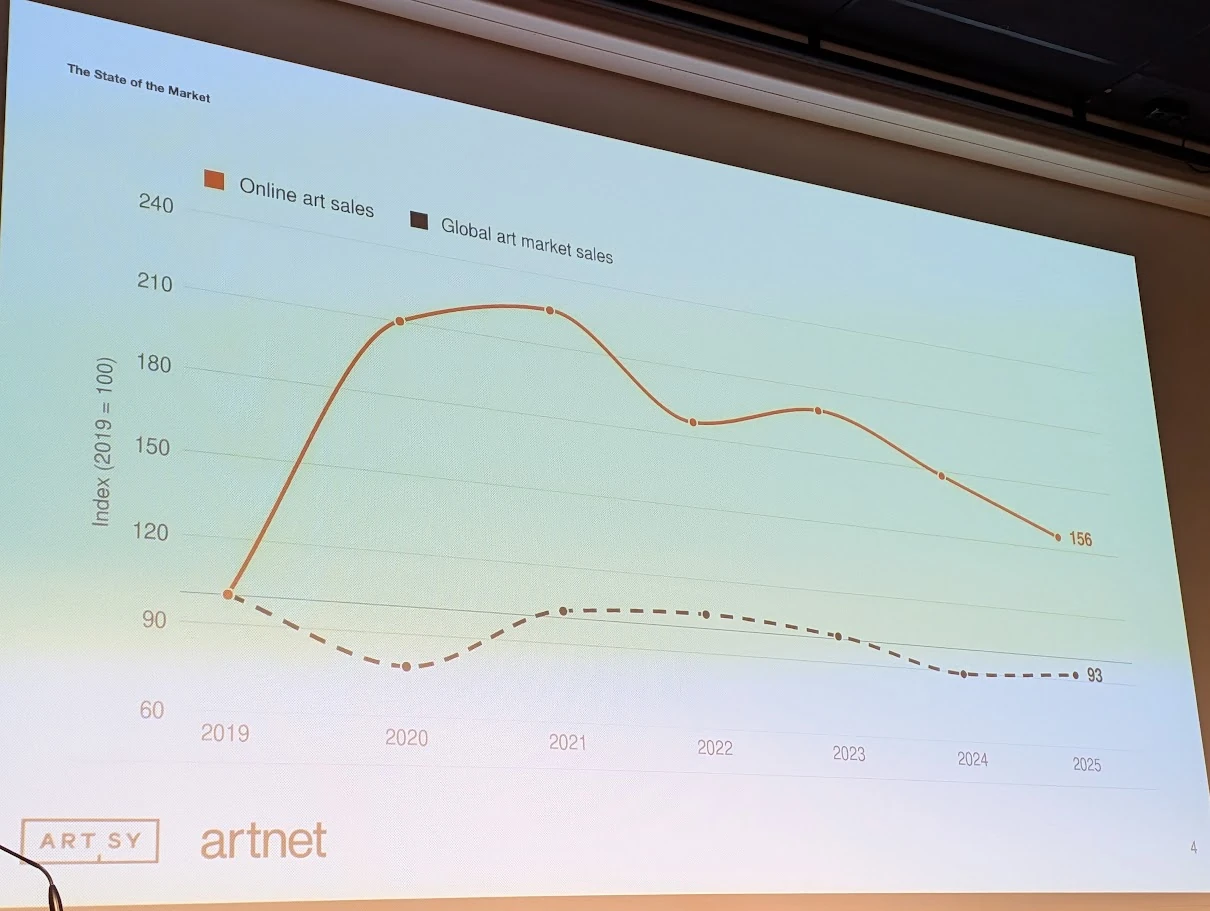
An online channel has its own demands. Images, descriptions, availability and enquiries all need care. A lower barrier to displaying a work does not make the entire sales process effortless. Nor does a falling online sales figure mean the internet has stopped helping people discover art.
Talking Galleries, 5 October 2026. Photograph by Bernie Torras; Artsy and Artnet branding is visible on the slide. The chart uses 2019 = 100 for each series, showing relative change rather than absolute market size. Online sales are part of total art-market sales.
The photograph above shows an indexed comparison presented at the conference. Each series starts at 100 in 2019. It compares change relative to that starting point, not the absolute size of online sales and the whole art market. The online series also sits within the broader market; they are not two independent markets to add together.
For a gallery, discovery and purchase may happen through several routes. Someone can see a work online, ask a question, visit the space and make a decision later. A channel's immediate sales figure may miss part of its contribution. It can also be tempting to credit every channel with the same eventual sale.
The practical task is to understand what each route does and what it asks of the team. That includes relationships which take time to develop, alongside a clear view of the workload they create.
A digital addition needs a manageable shape
These questions apply directly to AR. A digital layer can give an artist another way to present a work or help a visitor understand a particular choice. It also creates work: selecting material, producing it, approving it, testing the experience and keeping it available.
For a gallery considering Painta, I would begin with a defined selection and a limited purpose. A prepared collection can give several artwork experiences a sequence. That may make sense for a connected body of work, but the account scope, content responsibilities and visitor route still need to be agreed. Our article on collections, Scan and a single exhibition QR explains the practical differences.
The proposal becomes easier to assess when the team can describe both the visitor's benefit and the work required to deliver it. A useful question might be whether one approved explanation helps visitors notice a specific relationship between works. It should have an owner and a realistic plan for upkeep.
There is no reason to promise that this will remove physical storage costs or make shipping cheaper. Its value must come from the experience it actually creates. Our discussion of measuring an AR exhibition offers a way to distinguish access, use and a meaningful response.
If that contribution is worth exploring, a small pilot can keep the first commitment proportionate. The aim is to learn something useful while leaving the gallery enough time to do the work that gave the project a reason to exist.
Founder and creator of Painta.me. Artist in my spare time and AR art enthusiast. Building tools to help artists bring their creations to life through augmented reality.
A short weekly email with new Painta.me tools, practical AR ideas, artist opportunities, and ways to make your work easier to create, publish, and share. Useful even if you haven't created your first piece yet.
What you'll get
1
New AR tools
See what's new inside Painta.me and how it can help you create faster.
2
Artist opportunities
Open calls, featured works, community updates, and ways to get your art seen.
3
Practical AR ideas
Simple techniques to create, publish, and share better augmented reality pieces.
auto_awesome
Ready to create?
Create your free account, prepare an artwork and share it in augmented reality. Choose a paid plan when you need more.