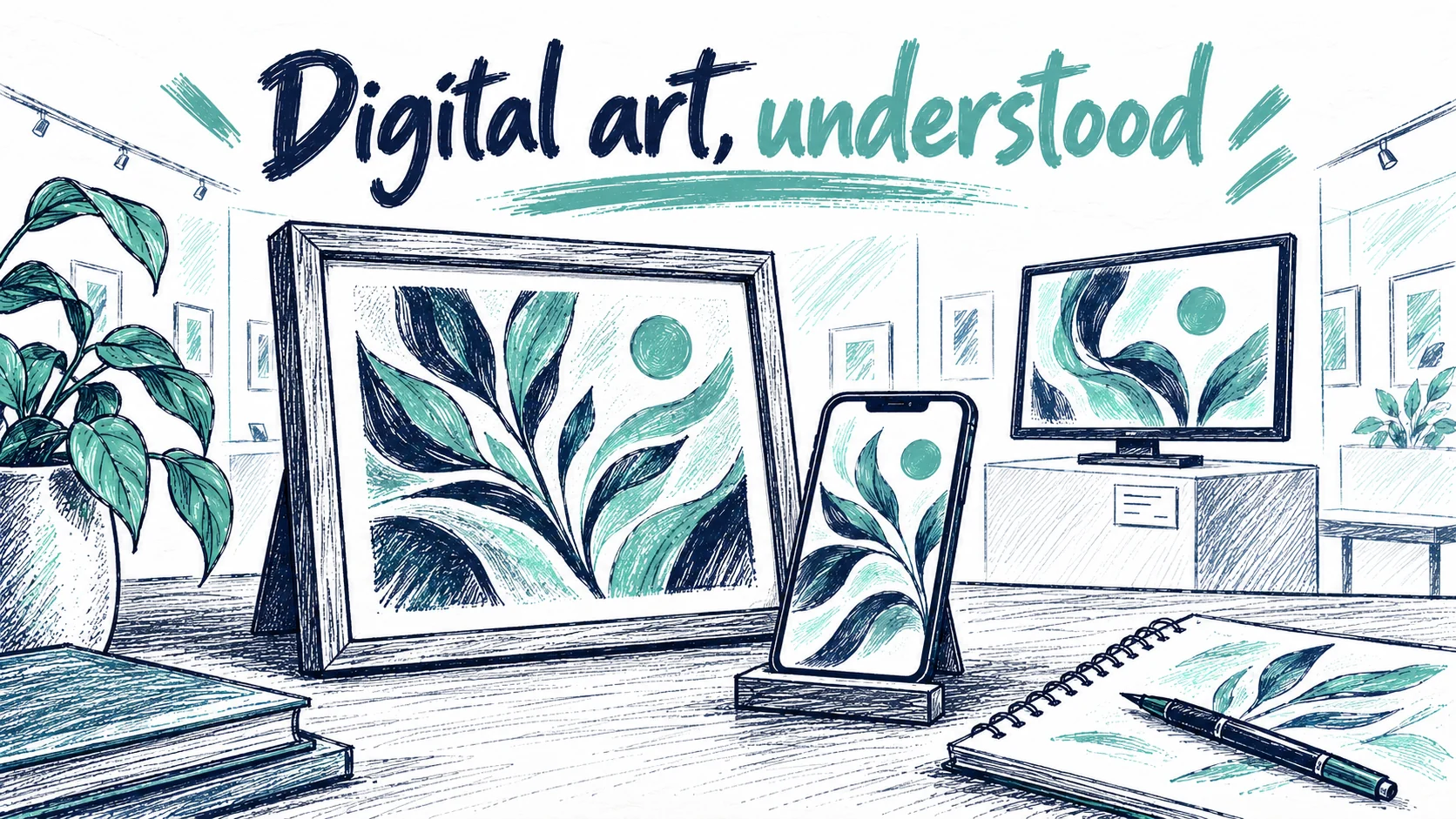
What galleries can learn from the wider world of collecting
person
Painta.me
Oct 22, 20267 min read
One of the questions I brought home from Talking Galleries was deceptively simple: what else does an art collector collect? The discussion moved beyond artworks to watches, cars, sports memorabilia and other objects around which people build knowledge, habits and relationships.
It would be easy to turn that into a story about whichever market is growing fastest. The more interesting question for a gallery is what people are doing when they collect. They may be following a maker, remembering a particular time, learning to recognise a detail or finding other people who care about the same thing.
Those motivations are worth exploring without assuming that all collectors behave alike. This article follows my reflections on Talking Galleries, using two photographs from the event as prompts for a closer look at the objects people choose to keep.
Photo: Painta.me | Original AI-generated editorial illustration. Conference photographs by Bernie Torras.
A striking comparison needs a second look
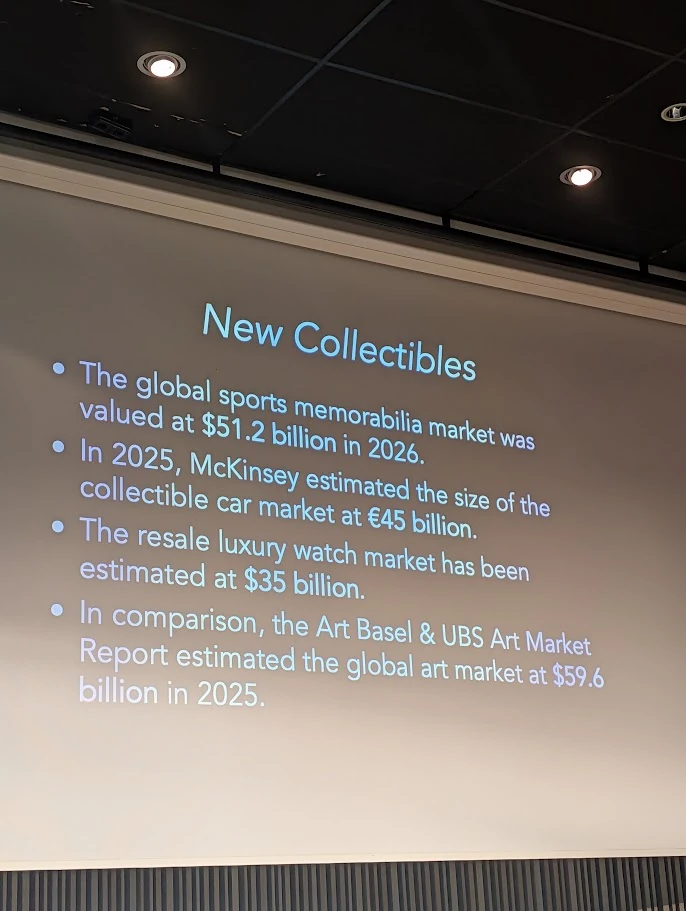
One conference slide placed estimates for several collectible markets beside an estimate of global art sales. Seeing the categories together made their breadth difficult to ignore. But the numbers do not all describe the same kind of activity.
Talking Galleries, 6 October 2026. Photograph by Bernie Torras. These estimates use different periods, currencies and market definitions and should not be read as a directly comparable ranking. The McKinsey car estimate is discussed and sourced in the text; the other category estimates are not independently verified here.
For example, McKinsey's February 2025 research on collectible cars estimated annual trade volume at about EUR 45 billion. Its definition of collectible vehicles included age, value and qualitative characteristics. That is different from the value of every car already held in collections, and different again from the revenue of businesses that restore or maintain them.
The slide also mixes currencies and reference periods. Other figures require their own source definitions before they can support a direct comparison. I would therefore read the photograph as an invitation to investigate a wider collecting landscape, rather than as a league table showing one category overtaking another.
The distinction matters for an artist deciding what to make next. A large market for an object does not establish demand for every creative proposal associated with it. It certainly does not tell us that adding a digital layer will make that object more desirable.
Even neighbouring categories can move differently
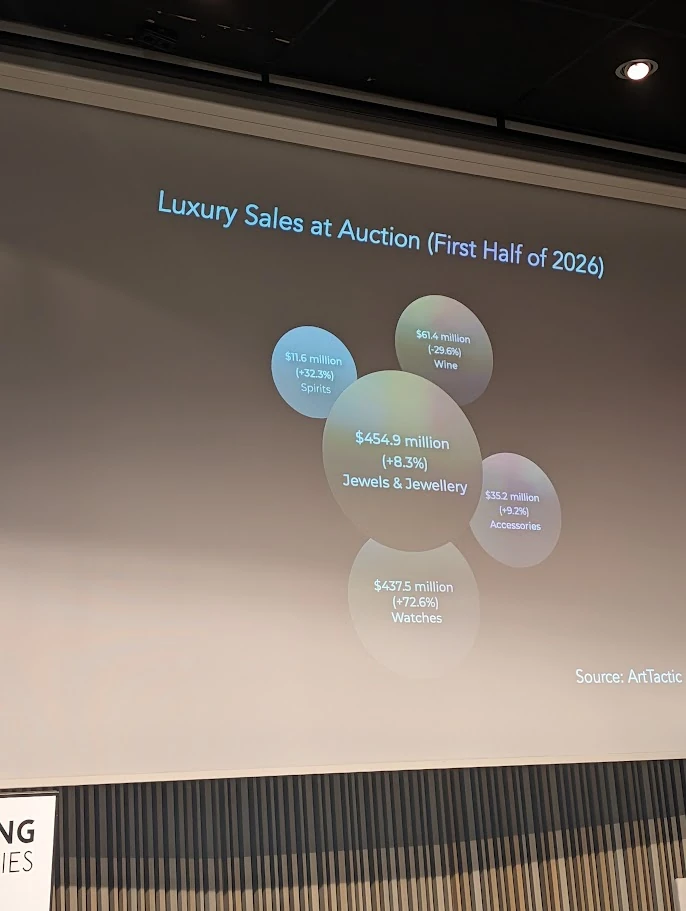
The other slide I photographed showed luxury auction sales in the first half of 2026, with ArtTactic credited as the source. Its categories did not all move in the same direction. Watches showed a strong increase, while wine showed a decline. The contrast is more useful than a blanket claim that luxury collectibles are booming.
Talking Galleries, 6 October 2026. Photograph by Bernie Torras; the slide credits ArtTactic. Figures are reproduced as presented. The public report description covers Christie's, Sotheby's and Phillips; it is not a measure of all luxury sales.
The public description of ArtTactic's report identifies its coverage as auctions at Christie's, Sotheby's and Phillips. It does not represent every retail purchase or private transaction in those categories. The values in the photograph are the figures presented at the conference; the public report description confirms the scope, not each individual value.
A gallery would want to understand a much smaller and more specific audience. Are people drawn to a particular artist's imagery? Do they collect editions because they follow the practice, because they enjoy a format, or because the work connects with something else in their lives? Those questions lead towards a conversation rather than a speculative product decision.
Knowledge can become part of the pleasure
Consider the difference between recognising an object and learning how to look at it. Someone interested in watches may begin noticing a particular construction. A reader may follow an illustrator across books and prints. A collector of cards may recognise variations that an occasional buyer would miss. These are examples of how attention can develop, not claims that every person in those communities has the same motivation.
Galleries already do a great deal of this work. They make introductions, place one body of work beside another and give people language for something they have noticed but cannot yet describe. A conversation can change what a visitor sees when they return to an object.
That offers an interesting perspective on digital interpretation. More information is not automatically a richer encounter. A specific piece of knowledge can be enough: why an artist returned to a motif, how an image developed, or what a change of material made possible.
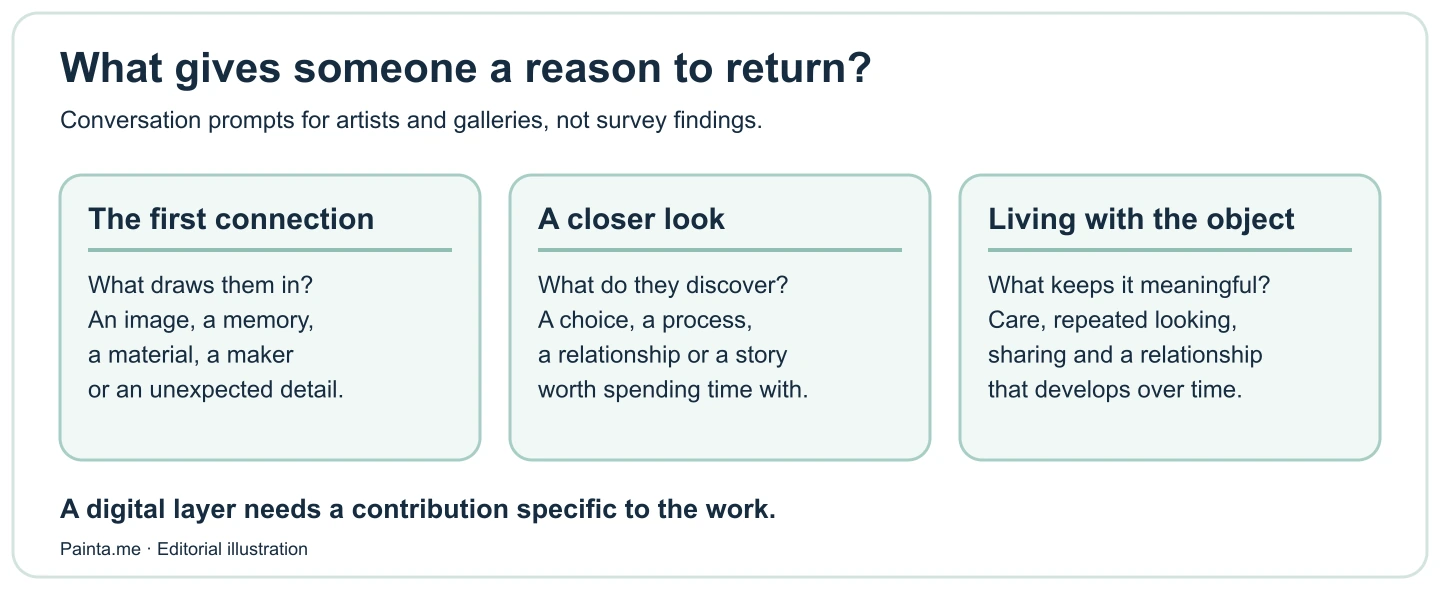
An original Painta editorial framework for asking about a collector's experience. These are prompts for conversation, not findings from a survey.
Imagine an artist's small print accompanied by a brief recording about a repeated shape. The recording would have value if it helps someone see the work differently or understand a choice they were curious about. A long biography may do less for that moment, even though it contains more facts.
A small format can hold a serious idea
Cards, books and editions can provide different ways into an artist's practice. Their scale changes how they are handled, displayed and shared. A card can move between people; a book gives an image a place within a sequence; an edition can make a particular work available in more than one home.
None of these formats needs to be treated as a lesser substitute for a large original. An artist can conceive a work specifically for the intimacy of a page or the repetition of a set. The relevant question is whether the format supports the idea.
There is also a difference between making a format more approachable and assuming that everyone who collects another type of object will become an art buyer. A gallery can learn about a visitor's existing interests without treating those interests as a sales lead to exploit. Asking what they enjoy looking at is a better beginning than assuming what they can afford.
The relationship after an acquisition matters as well. Our article on living with AR art considers how intention, everyday viewing and ongoing access become part of that experience. Those questions remain relevant whether the physical element is a substantial work or something small enough to hold.
Where an AR layer might belong
For an artist, AR opens one possible relationship between a physical image and additional material. An illustrated card might reveal a short motion conceived as part of its composition. A print might connect with the artist's explanation of a detail. A page might make the transition between two states of an image visible.
These are creative proposals to test. The particular image, surface, lighting and viewing distance matter. Image recognition is not the same as proving an object's authenticity, and opening an experience does not establish ownership of an edition. Those promises need to stay separate.
In Painta, the starting point can be a physical image with an artist-approved digital experience associated with it. A small group of connected works may also benefit from a prepared collection, where the order contributes to the story. The collection and Scan comparison explains why a prepared sequence and recognising an individual work serve different visits.
For a first experiment, choose a format the artist already cares about and a contribution that can be explained plainly. Show it to people who are interested in that work. Listen for what they notice and whether there is something they want to return to after the first reveal.
Our AR cards collection is a place to begin exploring the format. The opportunity is to give a particular object a thoughtful additional dimension. Its value should be visible in the encounter, without needing a claim about the future price of the object or the size of an unrelated market.
Founder and creator of Painta.me. Artist in my spare time and AR art enthusiast. Building tools to help artists bring their creations to life through augmented reality.
A short weekly email with new Painta.me tools, practical AR ideas, artist opportunities, and ways to make your work easier to create, publish, and share. Useful even if you haven't created your first piece yet.
What you'll get
1
New AR tools
See what's new inside Painta.me and how it can help you create faster.
2
Artist opportunities
Open calls, featured works, community updates, and ways to get your art seen.
3
Practical AR ideas
Simple techniques to create, publish, and share better augmented reality pieces.
auto_awesome
Ready to create?
Create your free account, prepare an artwork and share it in augmented reality. Choose a paid plan when you need more.